The Best Nation for the Best Religion
A Reading in the Qur'anic Scale of the "Bestness" of the Ummah, and Where We Stand Today
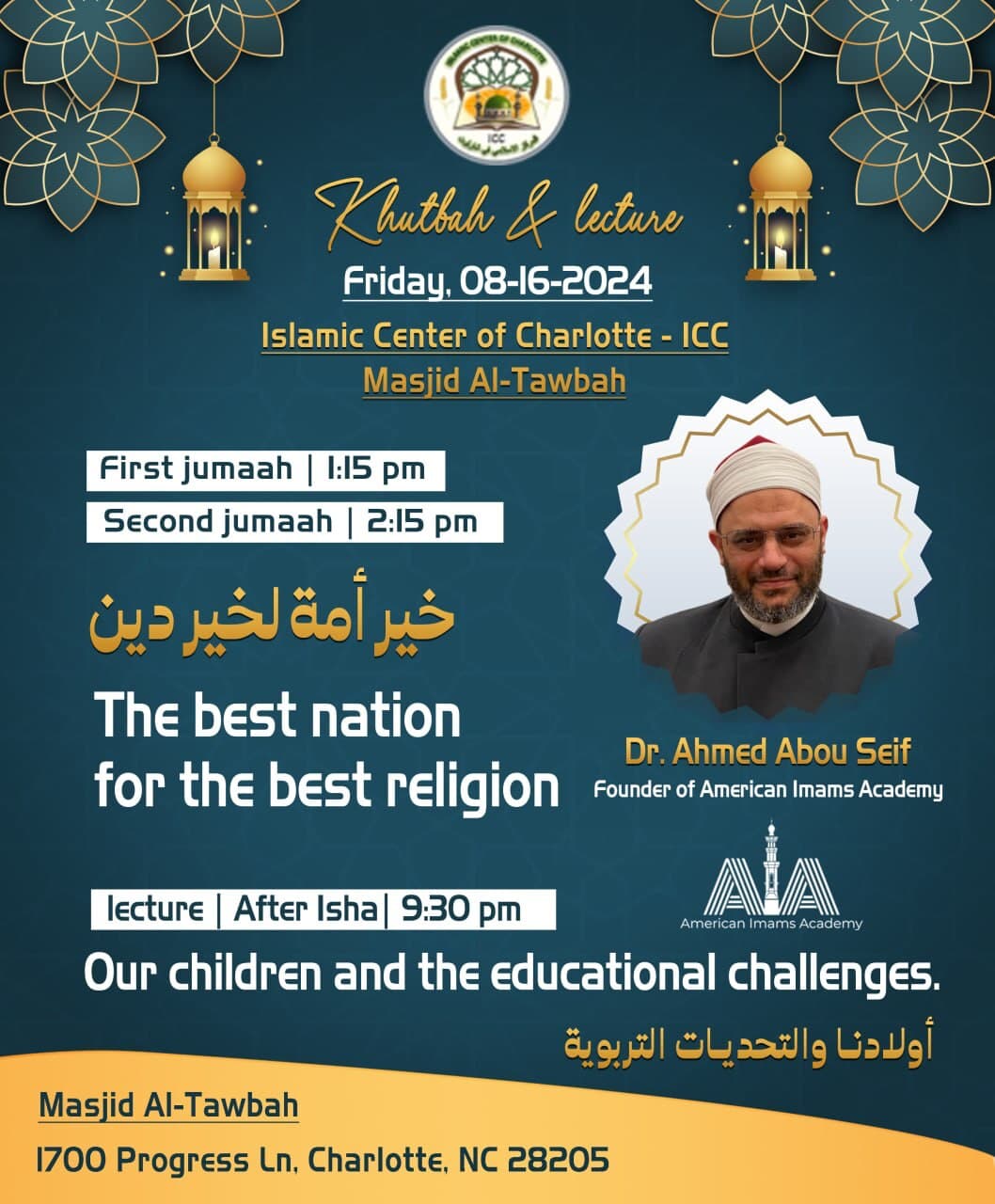
By Dr. Ahmed Mohamed Ali Abouseif, President of the American Imams Academy.
An Opening: When the Verse Is a Condition, Not a Description
*"You were the best nation produced for mankind. You enjoin what is right and forbid what is wrong, and you believe in Allah"* (Āl ʿImrān: 110).
No verse is invoked more often when Muslims speak about themselves. Preachers cite it, activists draw on it, authors put it on the covers of their books. But — from sheer overuse — it has become for some of us a free certificate of belonging, carried as if "bestness" were a gift bestowed for the mere fact of being Muslim.
The verse says the opposite.
"Bestness" in the Qur'an is not a medal of belonging — it is the responsibility of a function.
Read the verse again. Notice what it ties to "best nation": three conditions — *"you enjoin what is right,"* *"and forbid what is wrong,"* *"and believe in Allah."* Whoever fulfills these is of that community described; whoever neglects them has lost the description even if he carries the name. The verse is a measure, not a free pass.
I propose, in this article, that we stand together before this verse with honesty. No glorification. No self-flagellation. Just an honest question: Where are we today, by its measure?
I. "You Were" — Why the Past, Not the Present?
Notice the form of the verb: "You were" (*kuntum*), in the past tense. Not "You are." Not "You will be."
Commentators differ on its direction. Some held it carries the meaning of the present; others held it refers to what the community was like at the time of revelation. The position that seems most apparent is that it recalls what the community was at the time it fulfilled the conditions, and calls us to preserve that meaning[1]. As if Allah is saying: "You were the best nation the day you fulfilled the duty — preserve the meaning, and the description remains yours."
Then notice a second word: "produced" (*ukhrijat*) — a verb in the passive voice. The community did not produce itself; it was produced by Allah. For whom? *"For mankind."* Not for its own race, nor its own sect. **It was produced to *give* something to people, not to *take* from them.** This is a pivotal point. When the community turns inward, it forfeits the description of "bestness" — even while continuing to bear the name.
II. Religion Makes the Community, the Community Carries the Religion
The title "The Best Nation for the Best Religion" binds two terms in a precise reciprocal relationship:
Religion made the community. Before Islam, the Arabs were scattered tribes, locked in cycles of blood feud. Islam came and forged the scattered into a unity that transcended blood, tongue, and clan. The community, as we know it, was *born of* Islam — it did not give birth to Islam.
And the community carried the religion. Religion is a heavenly text that needs a human carrier to embody it as civilization. Without the community, the text would have remained in the Book and would never have entered history as a lived order. As has been said: "Muslims preserve the Qur'an, and the Qur'an preserves the Muslims."[2]
The relationship is reciprocal. If religion weakens within the Muslims, the community weakens. If the community weakens, the manifestation of the religion in the world dims. Neither side stands alone.
III. What Does "Bestness" Actually Mean?
A warning is needed here. Some readers may take "best nation" as a description of racial or inherent superiority — as if Muslims are better by their nature. This is rejected, for three reasons:
First: Islam itself rejects pride of race outright. On the day of the conquest of Mecca, the Prophet ﷺ said: *"O people! Allah has removed from you the haughty arrogance of pre-Islam and its pride in ancestors. People descend from Adam, and Adam is from dust."*[3]
Second: The verse named the conditions and did not name race. If "bestness" were racial, the verse would not have needed *"you enjoin what is right."*
Third: *"Produced for mankind"* points to a function, not a privilege. The community is best in proportion to its fulfilling the function — not by mere belonging of lineage or era.
**The community is not "the best nation" because it carries the *name* of Islam, but because it carries Islam's *message* to people.**
IV. Muslims in the West — The Opportunity of "Produced for Mankind"
Reflect — you who live in America — on your position before this verse. You are a minority. You have no authority over the law or the major institutions. **Does the description *"the best nation produced for mankind"* apply to you?**
Yes. In fact, you are in a rare position that allows you to fulfill its meaning in its purest form.
Because *"production for mankind"* means the community must be in contact with non-Muslims, presenting its model by example before words — introducing them to Islam not through introductory books, but through the conduct of the Muslim in the street, in the school, at the company, at the hospital. This is a daily, automatic contact for the Muslim in America — one the Muslim in Cairo or Istanbul rarely encounters.
Take a living example from among you: a Muslim physician at a Charlotte hospital, receiving one patient after another with patience and compassion, treating each with an etiquette his non-Muslim patients do not find in many of his colleagues. He writes no posts, gives no sermons — yet he embodies *"produced for mankind"* every single day. When a 75-year-old Christian woman walks into his clinic and meets the gentleness and care of his manner, she walks out with a question in her heart: "What is this religion that produces a man like this?" In that moment, this physician, alone, has become "the best nation produced for mankind" in his city.
Your position in the West is not a calamity — it is a mission. You represent Islam today in your society. People see it through you.
The Qur'an gives us beautiful examples: - The Negus in Abyssinia: he sheltered the first migration in Islam and preserved the religion in a land that was not the land of Muslims. - Joseph (peace be upon him) in Egypt: he became a minister in a non-Muslim state and used his office to serve justice and revive the land, without losing his identity.
Both are models for the Muslim in a minority: preserving his religion, working for the good of the society in which he lives, building a "bestness" that the people of the land perceive before the people of his own faith.
V. An Honest Diagnosis — Where Are We, by the Measure?
Open the scale on yourself, not on the *ummah*. Do you fulfill the three conditions?
**The First Condition: *You enjoin what is right*.** Many Muslims have retreated into a "religious privateness" that does not extend beyond the home. The concern has become only to reform the self. This is half the duty, not all of it. To enjoin what is right at your children's school, at your company, in the association you belong to — this is what is nearly disappearing.
**The Second Condition: *You forbid what is wrong*.** Forbidding wrong has become — in the age of social media — a matter of public shaming, not of counsel. We write harsh posts that alienate the one who erred instead of guiding him. The Prophetic forbiddance was wisdom and gentle exhortation — covering errors before exposing them to the crowd.
**The Third Condition: *You believe in Allah*.** Some may ask: why is faith listed as a *condition*? Is it not a pillar? The faith the verse speaks of is not the faith of belonging. It is the faith of an *active* heart — one that moves the believer from passivity to initiative. This faith is eroding today under the pressure of materialism, until for some of us faith has become a private emotional state lived in prayer, while we exit into life by an entirely different logic.
The general picture, for one who weighs himself honestly, is disquieting.
VI. Three Afflictions That Tear the Community from Its Bestness
What turned the community from its earliest state to its present one? Three interlocking afflictions:
Isolationism. That Muslims flee the world rather than serve it. Many of our communities in the West have become *isolated islands*: a mosque closed upon its regulars, Islamic schools that separate children from society, social ties that do not extend beyond the Muslim circle. This is a retreat that contradicts *"produced for mankind."*
Dependency. That we imitate the other instead of presenting our model. Our youth consume Western culture without filtration, and our academics import theories of ethics and politics without recourse to their own heritage.
Fragmentation. That Muslims have lost the sense of being a *single* community. Each lives his individual concern, or his national concern, or his sectarian concern. Where is the sense that you are part of a body — that when one limb complains, the rest of the body responds with sleeplessness and fever?[4]
VII. The Road of Return — What Do *I* Do Today?
The practical question with which the reader should emerge: What do I do, now? Here are four practical paths:
Begin with reforming yourself. Bestness does not begin with a perfect *ummah*; it begins with individuals who stand upright. Improve your prayer. Mend the relationship with your household. Learn a new virtue each month. Whoever is not best in his home, how shall he be best in his community?
Build a model in your field. Are you a doctor? Be the most just of doctors. Are you a teacher? Be the most beneficial of teachers. Are you a businessman? Be the most truthful of merchants. Islam spreads through the conduct of its people more than it spreads through books that introduce it.
Gather with your brethren around a great project. Individual work is not enough. We need *institutional projects*: schools, cultural centers, social services, endowments for orphans and the needy. Whoever does not gather with others around a project remains an individual — and is not a community.
Revive the global awareness. Know that you are part of a message for all people. Master the language of the age, listen to the questions of the age, and present Islam in a language understood by the people of the age. The Prophet ﷺ addressed every people in their own tongue.
Conclusion: "You Were" — A Past Tense That Inspires a Present
Return to the opening of the verse: *"You were the best nation."*
This *"was"* does not close a door — it opens one. Allah did not say *"You are the best nation"* as a settled verdict. He did not say *"You will be the best nation"* as a promise. He said *"You were"* — as if reminding us that this description was firmly true of the community the day it stood upon the conditions, and that it remains for whoever stands upon them, and slips away from whoever neglects them.
There are two choices: - Either we treat the verse as a *medal* we wear, taking pride and falling asleep. - Or we treat it as a *mission* reminding us that bestness is bound to action, not to belonging.
I pray we are of the second.
Dear believer in the West, perhaps Allah did not choose this exile for you in vain. Perhaps from the wisdom of this distant existence is that the *ummah* — through you — may remember that it was produced for mankind, not for itself.
Muslims lived for centuries in the lands of Islam, until some forgot that Islam is a message for the world. You today meet non-Muslims every day — at the university, at work, at the store. You transmit a picture of Islam to them, whether you intend to or not.
Make that picture beautiful. Make that message true. You will be — by Allah's leave — part of *"the best nation produced for mankind"* in your time: in Charlotte, in Tampa, in California, in New York, and in every place your feet alight.
O Allah, make us of "the best nation" not by name but by measure. Grant us to enjoin good with wisdom, to forbid wrong with mercy, and to believe in You with a living faith that moves through the body as blood moves through it.
And may Allah's blessings, peace, and benedictions be upon our Prophet Muḥammad, his family, and all his Companions.
Notes
- See *Tafsīr al-Qurʾān al-ʿAẓīm* by Ibn Kathīr, *Jāmiʿ al-Bayān* by al-Ṭabarī, and *al-Jāmiʿ li-Aḥkām al-Qurʾān* by al-Qurṭubī, on Allah's saying *"You were the best nation produced for mankind"* in Sūrat Āl ʿImrān.↩
- A phrase attributed to some later scholars, circulating in scholarly gatherings; we have not located a firm chain for it, so its meaning is cited tentatively.↩
- Reported by Abū Dāwūd (5116) and al-Tirmidhī (3955) from the ḥadīth of Abū Hurayra (may Allah be pleased with him). Graded ḥasan by al-Albānī in *Ṣaḥīḥ al-Jāmiʿ* (5198).↩
- A reference to the agreed-upon ḥadīth: *"The likeness of the believers in their mutual love, mercy, and compassion is the likeness of one body: if a single limb complains, the rest of the body responds with sleeplessness and fever."* Reported by al-Bukhārī (6011) and Muslim (2586) from the ḥadīth of al-Nuʿmān ibn Bashīr (may Allah be pleased with him).↩
Comments
Share a benefit or a thought about the article — we welcome your view.
No comments published yet. Be the first to comment.