Children of the Imams: Between Grace and Trial
Reflections on the Imam's Household, and Those Raised in It Between What People See and What the Family Knows
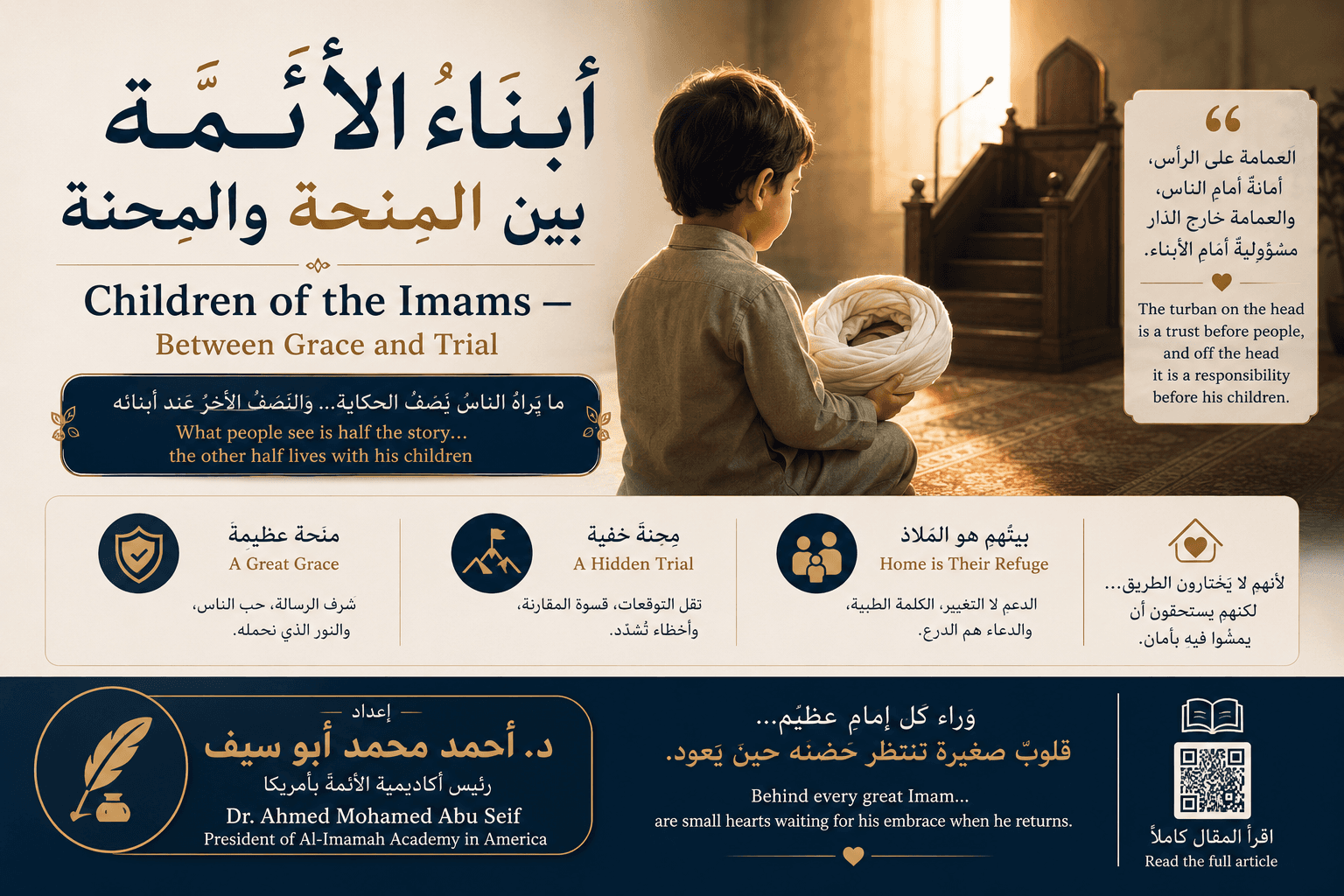
By Dr. Ahmed Mohamed Ali Abouseif, President of the American Imams Academy.
One Home, Two Worlds
There is a secret known only to those who have lived it: that within the imam's home there are not one but two environments. One that people see; and another that no one sees but he and his family. His children are the sole bridge between the two worlds, crossing it twice a day — once when they walk out with their father to the mosque, and once when they return with him to the house.
Not everything said here applies to every household. Doors differ, statures vary, and children's portions of ease and hardship are far from uniform. Yet the breath from which this wind blows is one and the same — and whoever finds himself in any of these images should know that he is not alone.
Outside, they see another man. They watch him lead the people in prayer, ascend the pulpit until necks fall silent before him, sought out for the settling of disputes, consulted in the gravest matters, his head kissed in reverence, pointed out wherever he goes. They see a man of dignity, ready of answer, firm of heart, as though he stands above what afflicts ordinary human beings.
Then they return home with him… and they see another man entirely.
They see him as a tired human being who removes his turban — and with it removes a portion of his awe. They see him sometimes sleep before the night prayer from sheer exhaustion, and sometimes stay awake until dawn carrying the burdens of others. They see on him the marks of marital disagreements that visit every home. They see him laugh and grow angry, succeed and err, rejoice and grieve. They see him — and this is the hardest of what they see — sometimes fail at what ordinary people manage with ease.
And this is none other than the way of the best who ever walked the earth ﷺ. ʿĀʾisha (may Allah be pleased with her) was asked: *What did he do in his house?* She replied: *"He was in service to his family; and when the time of prayer arrived, he would rise to the prayer."* A man in his home, an imam in his prayer-niche — a single step in distance between the two states, and an entire world of meaning. If this was the condition of the infallible one, what then of those below him?
So which of the two images is their real father? And whom do they believe — the people who see half of him, or their own eyes that see the whole?
The Paradox of the "Impoverished Eminence"
Among the most painful realities these children live is a silent paradox that few dare to voice: that the very father to whom people come with their needs — who urges charity and gives to the poor — sometimes finds himself in such straits that he has not enough in his hand to suffice his own home.
They watch people assume he must be well-off given his standing, while they themselves know that money in their house is scarce, that dignity conceals poverty, and that reverence does not feed a child bread. They see their father give away the last of what he has, then return home to find his own children awaiting from him what he no longer possesses.
This condition is no novelty in the houses of God's people. ʿĀʾisha (may Allah be pleased with her) used to say: *"Indeed, we — the family of Muhammad ﷺ — would let a month pass without kindling a fire; there was nothing but water and dates."* The house of the greatest imam who ever walked the earth, and this was its state! So the children of imams learn early that the "eminence" may be impoverished, that the "leader" may be exhausted, and that pulpits do not provision homes.
This is a harsh lesson for children — yet later it forges men who understand the weight of a word, and who know that true standing is not measured by what lies in a pocket.
When the Home Carries the Burdens of All the People
The imam's son does not merely live with his father; he lives alongside him the burdens of every person who comes to him. The father returns home laden with what stone itself could not bear: a wife who complained of her husband and whose pain pierced him; a deceased man whose funeral prayer he led, while the image of his bereaved family will not leave him; a sick person he visited, returning with a heart in pain; a quarrel between neighbors he tried to mend but could not; a wounding criticism from some who did not deserve to direct it at him.
All of this enters the house with the father. It sits at the table. It spends the night beneath the roof. It seeps into the children's hearts without their knowing. And Allah spoke the truth: *"Indeed, We shall cast upon you a weighty word"* (al-Muzzammil 73:5). The burden of the people is but a single ember of that weighty word — the father carries it on his pulpit, while the members of his household help him bear it in secret, from where no one perceives.
So these children grow up faster than their ages. They carry, while still small, what grown men do not. They learn to listen before they learn to speak, and they learn to swallow grief before they learn to give it voice.
The Trial of Identity: When Your Name Is a Shadow
Among the most intricate trials the imam's son lives is the feeling that he lives in his father's shadow rather than beside him. He scarcely meets a person before they hasten to say: *"You're the son of Sheikh So-and-so? Mā shāʾ Allāh!"* *"Surely you'll grow up to be just like your father!"* *"The imam's son… may Allah bless you!"*
Phrases of admiration on their face — but settling into his depths as a silent, wounding message: *Your value is not in you… it is in your father.*
A question grows within him that he dares not utter: *Do people love me because I am me, or because I am the imam's son? And will I remain, all my life, an appendage to someone else's name — even if that "someone" is the father I love?*
He then finds himself between two roads, both bitter: either he imitates his father by compulsion even if he does not resemble him — losing himself to gain the approval of others; or he rebels completely to prove he is someone else — losing something of his father to gain himself. Between the two roads, the real self is misplaced, and the question hangs unresolved: *Who am I, when stripped of my father's name?*
The truth is that Allah has fashioned every soul for its own affair, and the Truthful one ﷺ informed us: *"Each is made easy for that for which he was created."* The imam's son is not bound to be a copy of his father — but he is commanded to be a worthy version of himself. The prophets of Allah had progeny who walked their fathers' very road, and progeny who carved within righteousness a path different from their fathers'. The true heir is the one who inherits the meaning, not the form.
And the Daughters of Imams… A Doubled Trial
All that has been said of the sons has a doubled effect upon the daughters. The imam's daughter lives beneath two lenses: an eye that watches her because she is a woman, and an eye that watches her because she is the sheikh's daughter. She is held to account for her laugh, her dress, her companions, even her smile to a distant relative. It is expected of her — by her very nature, not merely by upbringing — that she be a model of modesty and decorum, as if she were born already reciting, remembering, devoted.
Within her own house she learns what no one else learns: to shield her father with her silence, to protect her mother with her discretion, and to smile at the women of the neighborhood after a long night of weeping. She has a right upon the community: the right to be treated fairly, before the right to be respected.
The Inheritance of Mistakes: When the Son Pays for What He Did Not Do
Then comes another, bitterer trial: that the son inherits not only his father's standing but his disputes — and people's interpretations of his father.
For the imam, however great his knowledge and piety, remains a human being who errs and is right. A view may come from him that he holds correct while others judge it mistaken. There may be those who lie in wait to attribute to him what is not in him. He may be criticized rightly at times and unjustly at others. And in all of this, the shrapnel reaches the children.
The son is then taunted with his father in gatherings, alluded to in schools, jabbed at in marketplaces. He hears about a man he loves words that pierce his heart. And he is forced — while still tender in years — to defend his father in places where he should have been nothing more than an ordinary young man laughing with his peers.
Allah has settled this matter with finality: *"No bearer of burdens shall bear the burden of another"* (al-Anʿām 6:164). Yet the customs of the marketplace and the gathering know nothing of this divine distinction! And so the son keeps carrying what he did not earn, called to answer for what he did not commit.
The cruelest part of the matter is that the son knows of his father what the detractors do not: he knows his mercy, his tears in prostration, his hidden charities, his sleepless concern for the people. He stands powerless between what he knows of his father and what people say of him. This is one of the deepest forms of solitude a human being can live.
Among Peers: A Loneliness of Another Kind
This solitude has another hidden face: the relationship between the imam's son and his peers. Children draw back from one they suspect to be a "watcher"; fathers warn their sons against playing in his presence — *"Don't play in front of him; his father will report to his father!"* — and teachers measure him by a scale different from his classmates': another's slip is overlooked, while his is held against him.
So the imam's son loses one of the greatest of childhood's blessings: spontaneity. He lives a childhood with half a laugh, friendships with half a heart. And this — by any psychological measure — is among the heaviest burdens a soul can bear.
When the Home Itself Becomes a Test
The trial intensifies when the family itself passes through an internal crisis: a dispute between the parents, an enduring tension, or — in the hardest cases — a separation.
Here the paradox reaches its peak. People see the imam as a symbol of stability and refer their disagreements to him so that he may reconcile between them, while the son sees, inside his own house, what no person would imagine. He lives a layered shock, and a painful question echoes within him: *How can one who mends others sometimes fail to mend his own home?*
And yet, contemplating this, we find that such trial is no innovation in the houses of the righteous. Nūḥ (peace be upon him) was tested through his son; Lūṭ through his wife; Yaʿqūb through his sons; Ayyūb through his family and his wealth. This did not diminish their rank with Allah by a single degree — rather it raised them by stations. The doors of trial upon the houses of daʿwah are wider — and the doors of reward upon them are wider still.
Then comes the cruelest part: the son — who bears no blame in the dispute of his parents — becomes, in society's reckoning, the inheritor of both their faults. He is reproached with his father before his mother, and with his mother before his father, and with both before the people. As if children had become — in the convention of some — a storehouse for the errors of fathers, and a field for the settling of scores.
In small communities this anguish is multiplied, for news travels swiftly, and the space of privacy contracts. The son lives between two walls: the pain of home from within, and the pressure of society from without.
Behind All of This… A Mother Who Bears the Home
The conversation about the imam's house is not complete without mention of the one who upholds its pillars from behind the curtain. The imam's wife lives the trial twice. Once by herself, when she carries her husband's absence on his children, and covers what he cannot give by her own presence — raising, teaching, shielding, enduring. And a second time, when she is commanded — by the custom of others — to keep her own trial silent: not to complain, not to grumble, not to ask anyone for what she rightfully deserves.
People see her as the sheikh's wife, and they assume in her what they assume in him — the perfection of the model. Women come to her with their questions; they look upon her home as if it were a garden of tranquility, while she knows — and dares not utter it — that a scratch in her household is like a scratch in any other, that exhaustion is exhaustion even when wrapped in the cloth of dignity.
If granted success, she is — after Allah — the greatest reliever of the trial upon her children. She pours into their hearts a tenderness that softens the harshness of the equation, translates for them the humanity of their father through her mercy, and makes of the home a cradle, not an arena. But if the burden has exhausted her, the children's suffering is doubled: neither a father fully present, nor a mother spared from being worn down. This — in the decree of Allah — is another field of patience, and another scale of reward, which the community ought not to forget when it remembers its imam.
The Face of Grace (1): A School Whose Doors Open to None Else
Despite all that has preceded, the picture is not entirely bleak. These children — if they are patient and reflective — leave this experience with fruits no one else can pluck.
They leave having seen religion alive, not merely as words. They saw the tears of repentance, the mending of relations, the hidden charities, the carrying of a community's burdens. They saw their father at dawn — broken — and on the pulpit — dignified — and they understood that dignity is itself a fruit of brokenness, that elevation begins from the ground. This is a school whose doors open to no one outside its walls, and whose diplomas are granted only to those who lived in its house for years.
The Face of Grace (2): An Early Closeness to the Great Meanings
The imam's child sits, from his earliest years, at the tables of the Qurʾān. He hears the exegesis of an āyah in the kitchen, the takhrīj of a ḥadīth on the threshold of the door, the fiqh of a contingency on the way to the mosque. He grows up with books around him, and the names of scholars on his tongue before others even know who they are. This is an environment for which others pay the price of years of study, while it is bestowed upon him along with his mother's milk.
He comes to know of the meanings of worship what leaves others at its surface. He knows the difference between a preacher addressing the people and one addressing himself before them. He knows that the dawn adhān is not a sound through a speaker, but a man's standing before his Lord before he wakes the sleeping.
The Face of Grace (3): A Character Absorbed Without Being Dictated
Among the greatest of what the imam's son inherits: humility before those who deserve it, and dignified pride away from those who do not. He sees his father kiss the head of an upright commoner, and turn away from the praise of a man of authority. He sees generosity from a narrow hand, preference of others in a moment of need, patient endurance of harm from one who, by every measure, deserved to be answered. These are virtues that may be taught from books — but what is learned through living can never be matched by any book.
Allah has made imamate the fruit of patience: *"And We appointed from among them leaders, guiding by Our command, when they were patient"* (al-Sajdah 32:24). Whoever was patient alongside his imam-father is the foremost among people to inherit his station one day — *if* he too is patient.
The trial, when read aright, turns into a grace of a deeper kind: a harsh upbringing, but an honest one — fashioning men and women who know life as it truly is, and who know the weight of a word because they have seen what one costs.
A Final Word: To Society — and to the Children Themselves
As for you, sons and daughters of the imams: hear it plainly before I lay down my pen. You are not shadows; you are an origin standing on its own. Your father's name is an honor, not a shackle; his legacy is a gift, not a sentence. Be yourselves within the expanse of what he bequeathed to you, and do not strive to be a copy of anyone — even if that "anyone" is the father whom you love.
Know that the trial cannot be read rightly except from both its angles together. Make of your homes a school, not a prison; make of people's pressure a mirror through which you discover yourselves, not a fate that writes you. Do not be ashamed to choose a path other than your father's, so long as it lies within the bounds of righteousness. How many a son of an imam took up medicine, teaching, craftsmanship, or writing — and carried his father's legacy in his own way, becoming a support to his family and a benefit to his community without ever ascending the pulpit. Imamate is an inheritance of meaning, not of form. Whoever is true in that inheritance, his father bears witness to his success — even if he never wore the turban.
And if people wound you, remember that the best of creation ﷺ was wounded by the closest of people to him, then was delivered and exalted — and you are more deserving of being delivered.
As for society, it needs to recognize that the imam is not a project of sanctification — he is a human being carrying a message. That he preaches mercy does not mean he will not grow angry. That he mends relations between people does not mean his own life is free of complication. That he is a caller to Allah does not mean his house has no need of prayer, of patience, of containment.
Perhaps among the greatest injustices done to imams and their children is this: that they are asked to live above the level of human beings, and then held accountable when they descend to the level they were always at. When people forget the imam's humanity, his children are the first to pay the price… and the first to deserve to be vindicated.
O Allah, as You entrusted our imams with Your message, preserve their offspring, and make them a comfort to the eyes of their fathers and mothers. Make them — they and their fathers — a comfort to the eyes of Your community. *"Our Lord, grant us comfort of the eyes from our wives and our offspring, and make us a leader for the righteous"* (al-Furqān 25:74).
Comments
Share a benefit or a thought about the article — we welcome your view.
No comments published yet. Be the first to comment.