Our Servitude — Between Deed and Word
A Reflective Reading on the Gap Between What We Say and What We Are
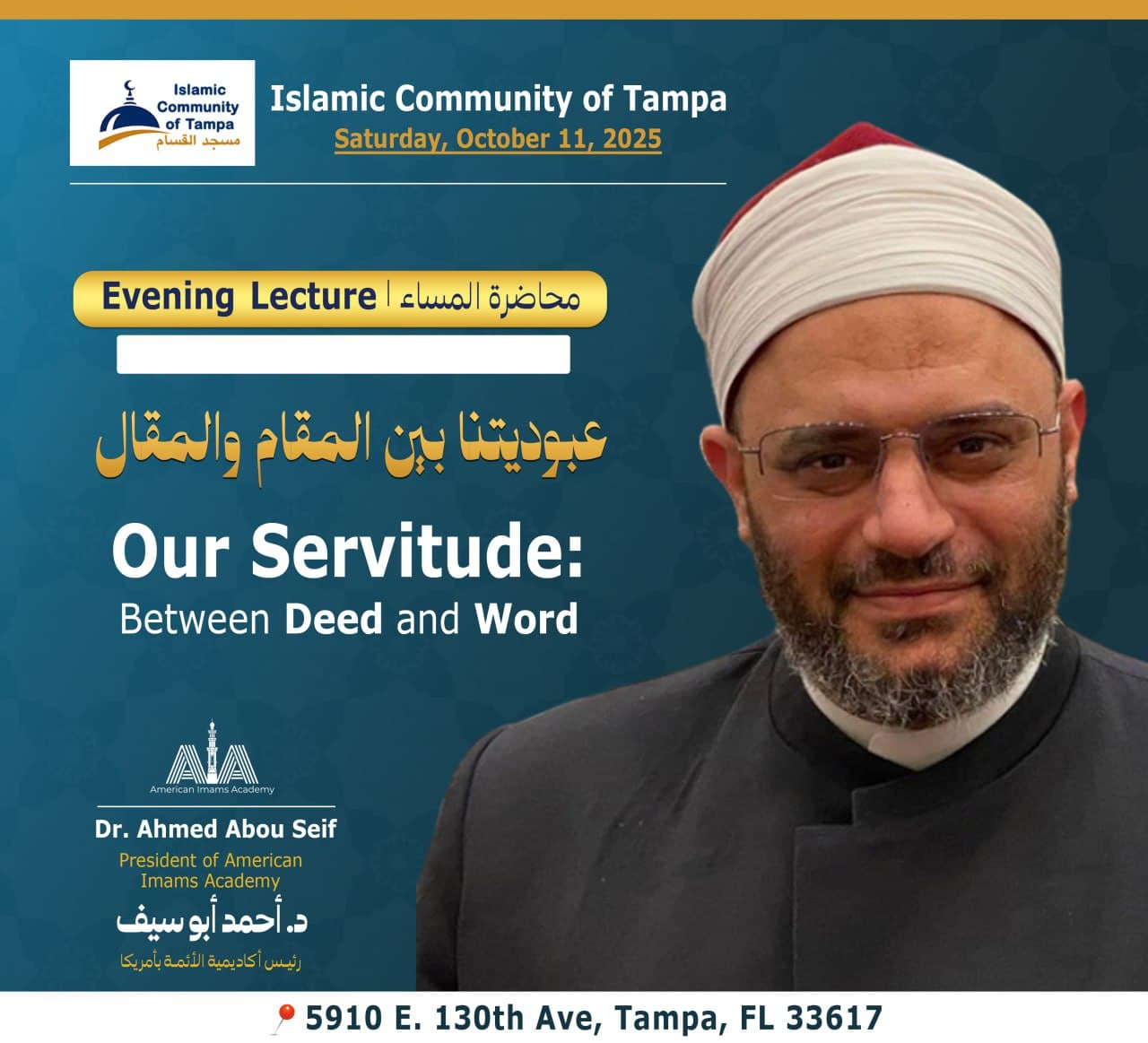
By Dr. Ahmed Mohamed Ali Abouseif, President of the American Imams Academy.
An Opening: "For Every Situation, a Fitting Speech"... and "For Every Speech, a Fitting Station"
The classical Arab rhetoricians measured eloquence by a famous maxim: *"For every situation, a fitting speech"* (*li-kulli maqāmin maqāl*). Earnest speech is not the same as jest; the words of consolation differ from those of congratulation; and what suits the gathering of kings does not suit the common marketplace. Whoever finds the right speech for every station — he is the truly eloquent.
But in religious matters, there is a deeper question: it is not enough that the believer finds the appropriate speech for every situation; rather, he must find for every word that escapes his lips a station within him that confirms it. **The point is not to say the word, but to *be* the word**. If you speak of asceticism, let there be in you a share of it. If you counsel patience, let your patience bear the weight of trial. If you call to monotheism, let yourself be purified of subtle idolatry in your intentions.
Notice the marvelous linguistic precision: *maqām* (station) and *maqāl* (speech) share nearly the same root letters (م-ق-ا-م / م-ق-ا-ل), differing in only one final letter. As if the Arabic language whispers to us: the distance between the word and the lived state is but one letter — yet that one letter contains an eternity of work. Whoever accustoms himself to speech without station, lives in a silent quarrel with himself, not realizing that he bequeaths to his heart a layer of hardness with every word his tongue extends without his chest settling around it.
This article is an honest attempt to stand together before the mirror of this scale and to ask: What is the ratio of our station to our speech? Have our words exceeded our states, leaving us strained and pretentious? Or have our states exceeded our words, leaving us bashful and humble?
I. What Is Servitude in Truth?
Before we measure the gap between station and speech, we must summon to mind what it is we are measuring. **Servitude (*'ubūdiyya*) is the very purpose of human creation**; Allah says: *"And I did not create the jinn and mankind except to worship Me"* (al-Dhāriyāt: 56). It is not, then, an ornament that the believer dons in his idle moments, nor seasonal obligations he sheds once performed; rather, it is the fabric of which the believer's entire existence is woven.
Ibn al-Qayyim opened wide the meaning of this in *Madārij al-Sālikīn* when he wrote: "Servitude is perfect love combined with perfect humility combined with perfect submission"[1]. Reflect on these three components:
- Love: the movement of the heart toward the Beloved — and this is a state, not a saying.
- Humility: the breaking of the self before the Magnificent — and this is a station, not a statement.
- Submission: the surrender of one's limbs in their actions — and this is a deed, not a theory.
Every definition of servitude offered by the verifying scholars descends into the realm of the inward before the outward, and settles in one's state before flowing onto the tongue. Whoever places servitude in its rightful position knows that remembrance of Allah without a present heart is speech without station, that prayer without humility is speech without station, that charity without sacrifice is speech without station, and that calling to Allah while afflicted by ostentation is speech without station.
II. The Decisive Qur'anic Scale
The Qur'an did not leave this scale to chance. Allah revealed two verses about it that are among the most terrifying warnings He has issued to His servants. He says: *"O you who have believed, why do you say what you do not do? Greatly hateful in the sight of Allah is that you say what you do not do"* (al-Ṣaff: 2-3).
Reflect on the points of intensity in this verse:
- It opens with "O you who have believed" — the address is not to disbelievers or hypocrites, but to the people of faith! This shows that the gap between station and speech is a disease the believer must fear *more* than others fear it.
- Then comes the term **"greatly hateful" (*kabura maqtan*)** — among the most severe words of censure in the entire Qur'an. *Maqt* is not mere dislike — it is detestation combined with contempt. This descriptor falls upon those who say what they do not do!
In another verse, the Qur'an strikes the example of some among the People of the Book: *"Do you order righteousness of the people and forget yourselves while you recite the Scripture? Then will you not reason?"* (al-Baqara: 44). The luminous meaning here is: that whoever orders others by his speech but forgets himself by his station has *lost his very reason*! Reason — in the Qur'anic scale — is not sharpness of mind, but the human capacity to be *present to oneself* in everything one says.
In the methodology of all the prophets you find the same model. Shu'ayb (peace be upon him) addressed his people, saying: *"And I do not intend to differ from you in that which I have forbidden you; I only intend reform as much as I am able"* (Hūd: 88). This is the scale of the prophets: they never forbade their people anything until they had first kept themselves clear of it.
III. Three Degrees of Servitude
From contemplating these verses and traditions, three degrees of servitude become clear:
**The First Degree — The Servitude of Speech (*'ubūdiyyat al-maqāl*):** The servant worships his Lord with his tongue — remembering Him, calling upon Him, glorifying and praising Him — yet the heart is silent, the limbs are heedless, and the conduct has not been touched by any of these utterances. This is the lowest degree, and it can descend into a dangerous practical hypocrisy if affectation overwhelms it.
**The Second Degree — The Servitude of Station (*'ubūdiyyat al-maqām*): The servant worships his Lord with his state. His silence is remembrance, his deliberation is worship, his stillness is humility, his dealings are excellence. He speaks little in all this — ashamed to speak of what he does not possess. Many of the early righteous were in this degree. al-Hasan al-Basri said: "The believer is a guardian over himself, holding himself accountable for the sake of Allah"** — a guardianship of station, not of statement.
**The Third Degree — The Servitude of Unity (*'ubūdiyyat al-jamʿ*):** Here the station coincides with the speech. The servant says only what he has realized, and does not realize what he has the capacity to speak of, lest he fall into self-admiration. This is the degree of the complete ones, whose hearts have been delivered from duplicity. Their state speaks before their tongue, and their tongue dares not utter anything except as a translation of what their state has witnessed. In this degree the Prophetic ḥadīth on the reality of *iḥsān* (excellence) descends: *"That you worship Allah as though you see Him; for if you do not see Him, truly He sees you"*[2]. Whoever feels this divine watching does not utter a word except by its measure.
IV. Models from the Salaf — Those Who Inhabited the Station Before Voicing It
The legacy of the early generations in this domain is an inexhaustible spring, full of unveiling lessons:
ʿUmar ibn al-Khaṭṭāb (may Allah be pleased with him) used to weep so profusely before speaking from the pulpit that he would sometimes throw himself upon the ground, grasp a handful of dust to place on his head, and say: *"Would that the mother of ʿUmar had never borne ʿUmar"*[3]. This is station preceding speech — a state that prepares the heart before the sermon proceeds from the tongue.
Sufyān al-Thawrī described Wakīʿ ibn al-Jarrāḥ thus: "I have never seen anyone more ascetic than Wakīʿ. I saw him as an old man with a face like snow, as if he were standing in the very presence of his Lord"[4]. Notice: he did not say "I *heard* him speak about asceticism," but rather "I *saw* him." Asceticism is a station to be witnessed, not a saying to be heard.
Mālik ibn Dīnār used to say: *"Hearts rust as iron rusts; and their polish is the remembrance of Allah"*[5]. But the remembrance that polishes the hearts is not the movement of an unconscious tongue; it is a remembrance that flows from the tongue to the heart, igniting it with wakefulness and watchfulness.
al-Fuḍayl ibn ʿIyāḍ said: *"Fear remained with us until it became joy in our hearts"*[6]. This is the logic of one who speaks from his inner depth, not his outer surface. Fear with him became a settled station, and the soul grew familiar with it, until Allah granted from this same heart a joy springing from watchfulness rather than from heedlessness.
The common thread among all these figures: They never spoke except of what they lived, and they never lived except in what they believed.
V. The Contemporary Gap — An Age of Inflated Speech and Withered Station
We live — and let us be honest — in an age that has inflated speech at the expense of station. Talk of faith has multiplied to the point that faith itself has been buried beneath its rubble. Social media has built a pulpit for everyone: each one speaks about religion, each one preaches, each one issues fatwas, each one disseminates advice. But **what is the ratio of what is *published* to what is *lived*?**
Let us descend from the general to the particular with three examples from our reality today:
The First Example: A famous preacher on Instagram, who writes every morning a post about asceticism and reliance upon Allah. His words flow with refined spiritual phrases that touch the hearts of hundreds of thousands. Then — when he descends from his digital pulpit — he opens his phone every three minutes to check his follower count, and grows agitated if his engagement rate on a post is low. Is his speech on asceticism a lie? No, the speech is sound in itself. But where is his station within it? Lost beneath the rubble of numbers.
The Second Example: A Muslim father in America who gathers his children every week to study Qur'an with them, telling them of the duty to revere the Book of Allah and to maintain a relationship with it. Then he enters his room, opens his phone on social media, and spends hours of the night in aimless scrolling — and has not touched a *muṣḥaf* in weeks. Is his counsel to his children correct? Yes. But where is his station in relation to his speech? The children *see*, even when they do not voice it.
The Third Example: An activist in community matters, who speaks at conferences about justice, writes in newspapers about the rights of the oppressed, and lectures about the duty of excellence. Yet his wife at home suffers from his coldness, his children from his short temper, and his employees from his unfair dealings. Is his defense of justice wrong? No — defense of justice is itself just. But where is the station of justice within him? As if he forgot that justice begins at home before being generalized to the *ummah*.
In these three examples — and in many more we know all too well — the disease of our age becomes manifest: excess in speech with atrophy in station. So much so that some have come to believe that publishing a post about virtue suffices for its practice, that sharing a verse on WhatsApp suffices for its contemplation, and that commenting on a religious video suffices for its application. This is anesthesia, not refinement.
VI. Three Afflictions That Tear Station from Speech
What causes the believer to become severed from his station and float on the surface of speech? Three principal afflictions:
**The First Affliction: Ostentation (*riyāʾ*).** That your speech be for people and your station only momentary fragments before a lens or in the presence of a witness. Ostentation — as the Prophet ﷺ warned — is the lesser polytheism[7]. Among its dangers is that its possessor may not be aware of it; a man may give a sermon excellently, write beautifully, call to Allah movingly, and then find in his heart a hidden joy at praise greater than his joy at reward. Here the affliction descends, and speech becomes severed from station.
The Second Affliction: Self-admiration in Knowledge. That a person imagines knowing the road dispenses him from walking it. So he overloads himself with reading in books of purification, listening to lectures on asceticism, memorizing texts on excellence — until he comes to think he has *reached* those stations merely by knowing them! I say this honestly: a person may memorize Imam al-Ghazālī's entire *Iḥyāʾ ʿUlūm al-Dīn* and gain nothing of its spirit, if he does not enact its deed. The legacy of the prophets is bequeathed through action, not memorization.
The Third Affliction: Haste. That the believer speaks before the meaning has settled in his chest. He hears a beautiful word or deep idea and rushes to publish it, write about it, or speak of it as if it were his own — when in truth he has not yet digested it, has not yet brought it into the cycle of his own experiences, has not yet allowed it to touch his heart. So he releases speech before the station has settled.
A delicate report on this matter: one of the early devotees, upon hearing a hadith or a wisdom, would restrain himself from speaking of it for weeks, until he had verified its descent into his life. Only then, if he uttered it, would he speak from a pure source. What a vast distance between their age and ours!
VII. A Practical Map for Bridging the Gap
How does the believer treat this gap? Five gradual steps, accessible to every sincere believer:
The First Step — Begin with Silence: Before you open your mouth in matters of religion, ask yourself: have I *lived* what I am about to say? If you hesitate to answer, prefer silence. The Prophet ﷺ said: *"Whoever is silent is saved"*[8]. To be silent about a state you have not lived is better than to utter words that enter you through the gate of divine displeasure.
The Second Step — Solitude: Sit with yourself daily — even for a quarter hour — and reflect: Where am I in relation to Allah? What did I say today that I did not enact? What did I do that I would never have uttered in the presence of the righteous? This solitude reveals to you mirrors of yourself that remain hidden amid the press of people.
The Third Step — Daily Self-Accounting: At the end of your day, take one measure: compare every word you wrote or spoke about religion with a corresponding act. Did you write about patience? Did you exercise patience in a single situation today? Did you speak about excellence? Did you treat your family with excellence? If you took this measure for a single day, it would reveal to you of yourself what you cannot imagine.
The Fourth Step — Gradualness: Do not hold yourself accountable to the highest stations; begin with the lowest degree you can truly fulfill. Do not say: "I shall be like al-Hasan al-Basri in his fear." Rather say: "I shall make one prayer today with concentration." Then build upward. Servitude is a sapling that is watered day by day, not a tree planted in a single moment.
The Fifth Step — Sitting with the Sincere: Seek out those who truly inhabit their stations, even if their words are few. Sit with them and listen. You will transmit more from their state than from their speech. As inherited wisdom has it: whoever wishes to discipline himself should sit with one whose silence suffices him without his need for that one's words[9].
Conclusion: Our Servitude Is a Conversation Lived, Not Words Spoken
Dear believer, the legacy of the Prophet ﷺ is not a collection of sermons and exhortations, but a life that is lived. This is why Allah named the Qur'an *"the most beautiful of conversations"* (al-Zumar: 23) — not "the most beautiful of speech." For *ḥadīth* (conversation) is what passes between heart and heart, while *kalām* (speech) is what runs upon the tongue. Our true servitude is that we be a beautiful conversation, not abundant speech.
I close with three counsels, offered to myself before I offer them to you:
- Speak no word about religion that has not descended into your heart before descending onto your tongue. If it has alighted first in your heart, it will emerge from your mouth with a light that captures the souls of those who hear. But if it leaves your mouth without passing through your heart, it will reach the ears of listeners cold and dead.
- Keep between yourself and Allah a secret upon which no creature looks. A righteous deed you hide from the eyes of people, a whispered prayer in the depths of night, a tear upon your pillow. Whoever has a secret with Allah, his speech penetrates hearts without his realizing.
- **Know that the most dangerous trap awaiting the seeker of knowledge is to imagine he has *arrived*. Whoever supposes himself to have attained a station has, in truth, drifted from it without knowing. In the inherited wisdom of the righteous: Whoever sees his own obedience as much, Allah sees it as little; and whoever sees his own sin as little, Allah sees it as much**[10].
I ask Allah the Magnificent, Lord of the Mighty Throne, to make our station greater than our speech, our action more truthful than our words; to grant us sincerity in secret and in public; to make our final speech in this world the testimony "There is no god but Allah"; and to accept from us and from you the good of our deeds.
And may Allah's blessings, peace, and benedictions be upon our Prophet Muḥammad, his family, and all his Companions.
Notes
- *Madārij al-Sālikīn bayna Manāzil Iyyāka Naʿbudu wa-Iyyāka Nastaʿīn* by Ibn al-Qayyim (1/100 and following), in his treatment of the reality of servitude.↩
- Reported by Muslim in his *Ṣaḥīḥ* (8), from the ḥadīth of ʿUmar ibn al-Khaṭṭāb (may Allah be pleased with him) — within the long ḥadīth of Jibrīl (peace be upon him), where he asked about Islam, faith, and excellence.↩
- A well-known report in the works recording the biography of ʿUmar (may Allah be pleased with him), including *al-Zuhd* by Imam Aḥmad and *Ḥilyat al-Awliyāʾ* by Abū Nuʿaym. Transmitted with various close wordings.↩
- A renowned report in the works of biography and *rijāl*, transmitted by more than one chain from Sufyān al-Thawrī describing Wakīʿ ibn al-Jarrāḥ.↩
- Reported by al-Bayhaqī in *Shuʿab al-Īmān* (519) from Mālik ibn Dīnār. It has several close paths.↩
- A famous report from al-Fuḍayl ibn ʿIyāḍ, transmitted by more than one biographer.↩
- An allusion to the ḥadīth: *"What I fear most for you is the lesser polytheism."* They asked: "And what is the lesser polytheism, O Messenger of Allah?" He said: *"Ostentation."* Reported by Imam Aḥmad in *al-Musnad* (23630) from Maḥmūd ibn Labīd (may Allah be pleased with him). Graded ḥasan by al-Suyūṭī and al-Albānī.↩
- Reported by al-Tirmidhī (2501) and Aḥmad (6481) from ʿAbd Allāh ibn ʿAmr (may Allah be pleased with them). Graded ḥasan by al-Albānī in *Ṣaḥīḥ al-Jāmiʿ* (6367).↩
- From the inherited speech of the early generations, attributed to several among them with close wordings; we have not located a firm chain for it, so it is cited tentatively.↩
- Also from the inherited speech of the salaf, transmitted from a number of the gnostics; we have not located a firm chain for it, so it is cited tentatively.↩
Comments
Share a benefit or a thought about the article — we welcome your view.
No comments published yet. Be the first to comment.