Where We Stand in the Sentence of History
A Reading of the Believer's Position When the Mill of Events Turns
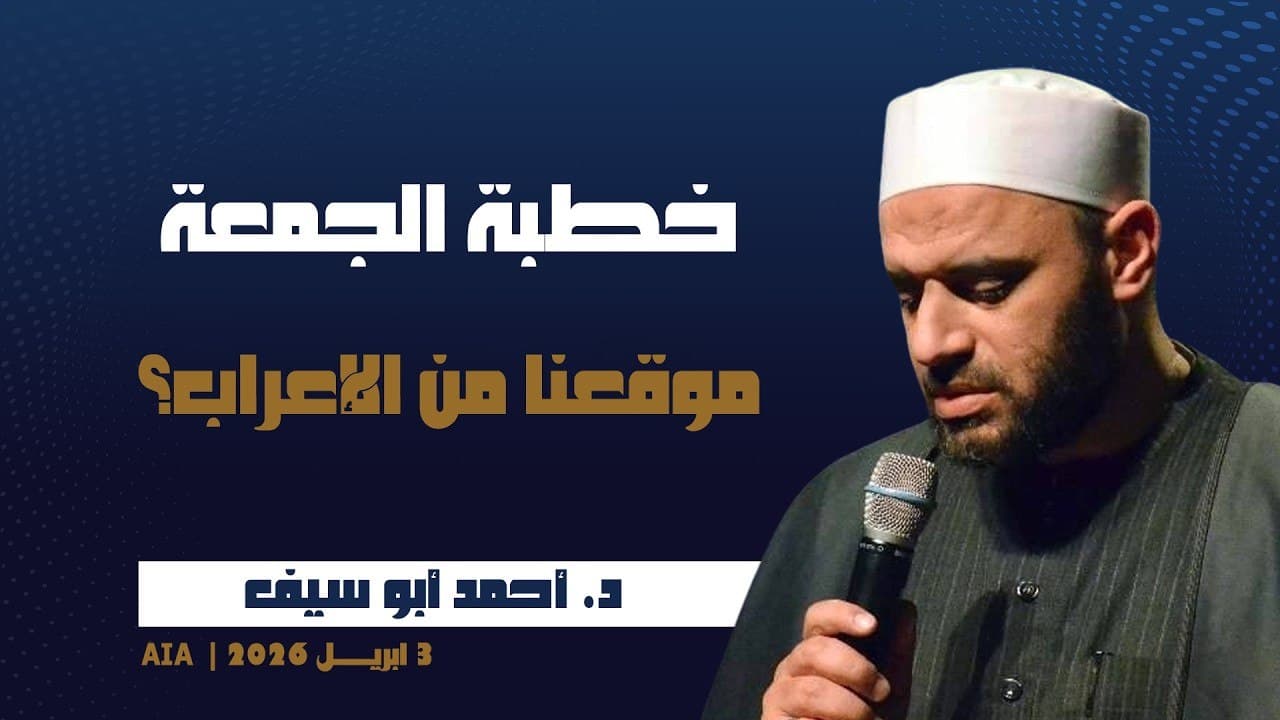
By Dr. Ahmed Mohamed Ali Abouseif, President of the American Imams Academy.
An Opening: Parsing in the Sentence, and Parsing in the Event
In our childhood, we learned that every word in an Arabic sentence has a grammatical station (*iʿrāb*): subject, object, circumstantial, predicate. If the station fails, meaning collapses. "Zayd" cannot stand as subject if you mean him as object; he cannot be in the nominative if he belongs in the genitive. A word is what its station says it is — not what its letters spell.
So too with the believer in events: he has a station before each event that he ought to know. If he loses it, the inner scale breaks, and the outer testimony falters. You — O believer — are a word in the sentence of history. What is your station in the parsing of this sentence?
This is the question we contemplate today as we look at what unfolds around us — looking from above, not from within. From above the clouds, where the courses of rivers are seen in their full sweep, not from the riverbed, where one sees only mud and stone.
I. Sūrat al-Rūm — When War Falls Between Two Disbelievers
Allah opened Sūrat al-Rūm with a tale strange on its surface, marvelous in its reality:
*"Alif Lām Mīm. The Romans have been defeated in the nearest land, but after their defeat they will overcome — within a few years. Allah's is the command, before and after. And on that day the believers will rejoice in the help of Allah. He helps whom He wills, and He is the Almighty, the Merciful"* (Al-Rūm: 1–5).
The wonder in these verses is many-sided. The Romans were not Muslims, and the Persians were not Muslims. A war between two disbelievers, in which one defeated the other — why should the Qur'an concern itself with their tidings? And why does Allah tell us that "the believers rejoice" at the defeat of one and the victory of the other?
The commentators answered: the Persians were Magians worshipping fire, the Romans were People of the Book, and the victory of the People of the Book — though not Muslims — was closer to the people of faith than the victory of the pagans[1]. So the Muslims rejoiced at Rome's victory over Persia.
But in the verse there is a subtler point still. The Qur'an teaches the believer to have a "station within the parsing of the event" even when all the actors are non-Muslim. You are not a field combatant in every war — but you are a scale. You possess for every event a *gaze* by which you read where the relative truth lies against the relative falsehood, and by which you read the event's consequence upon the fate of faith in the world. This is Qur'anic insight.
II. When the Mill Turns Between Two Powers, Neither of Which Is Ours
Today — as we close the first quarter of the fifteenth Islamic century — the mill turns before us between powers, none of which represents the Abode of Islam in any total sense. Wars in the region; clashes between states whose schools and projects differ; and behind each party, a policy that serves the great powers who stand behind it.
The believer who looks at this sentence from the sky — not from the ground — asks himself three questions:
- What is my station in this parsing?
- Am I an actor armed with a sword, or a witness armed with a scale?
- What should my heart rejoice at, and what should it grieve over?
These are not abstract questions. These are questions every Friday sermon places before whoever listens with his heart before his ear. Because it is not given to the believer to detach himself from the body of the world and say, "This is a matter among people I do not know, what have I to do with them?" For what unfolds in the world reflects upon the Abode of Islam, reflects upon the standing of the Muslim, reflects upon the announcement of Islam upon the earth. The believer who does not feel this has lost his station in the parsing.
On the other side, it is not given to him to enter into every battle as if he were a partisan in it — absorbing this faction's air and hating that faction's enemies. The Qur'anic scale is not tribal alignment; it is judgment after reflection.
III. The Trial of Schadenfreude — When Joy in Faith's Triumph Is Confused with Joy in a Brother's Defeat
The most dangerous thing that may face the believer in a time like this is to confuse two matters:
- Rejoicing at the help of faith: a rejoicing he is commanded to feel, as the Companions rejoiced at Rome's victory over Persia.
- Schadenfreude toward a sect of Muslims tried by war: a quality the Messenger ﷺ forbade in a narration of weak chain from Wāthila ibn al-Asqaʿ: *"Do not show schadenfreude toward your brother, lest Allah have mercy on him and try you."*[2] Its meaning is corroborated by the foundational principles of the Sharīʿa and the ethics of faith.
The confusion between these two is lethal. Some Muslims today look at the suffering that befalls a sect not of their school in war and rejoice. They suppose this rejoicing belongs to "the victory of the Sunna" or "the triumph of truth." It is, in truth, schadenfreude — not the joy of faith.
The rule for Qur'anic rejoicing is this: we rejoice when faith — as a whole — is granted victory over disbelief — as a whole. Not when a Muslim is broken — even one who differs from us in the branches of doctrine — under blows that are Zionist or regional, not Islamic in any sense.
The Muslim who hears that a home was destroyed in a suburb whose people follow a school other than his own, and who says in his heart, "they reaped what they sowed" — that Muslim has lost his station in the parsing. For the body under the rubble is a Muslim, and the displaced is a Muslim, and the orphan is a Muslim. What lies between the schools in branch differences does not strip away from any of them the name of Islam.
Schadenfreude toward a Muslim — whatever his school — when calamity descends upon him from non-Muslims, is a quality that does not grow in a heart that knows the scale of faith.
This does not mean we erase the differences between the schools, nor that we equate the one who reached the truth with the one who departed from it. It means we put each thing in its station: doctrinal disagreement is treated in the books of jurisprudence and creed, not in joy at a Muslim's misfortune. Parsing in its place.
IV. The Muslim in the West — A Third Station
Where do we stand — we Muslims in the West — in this parsing?
We are not a military party, nor a geographic theater of conflict. But we are at the heart of the event from two directions:
- The first: the political system under whose shade we live is itself the agent in many of those events; it supports this, restrains that, and holds the reins of the world's grand policy.
- The second: the picture of Islam in the people's minds here is drawn by us — by our conduct, our speech, and our stance.
From these two directions: a doubled duty falls upon us.
In the first direction: we ought to address public policy as people of insight, not people of inclination. When we object to a policy of the current era — such as the harsh campaign against immigrants, or the discourse of restriction upon Muslims, or the support of wars whose victims are innocent civilians — we object with the tongue of truth, not the tongue of party. We say "this is injustice" because it is injustice, not because it came from this man rather than that. Injustice is injustice, whatever its source. In elections, we cast our votes upon the scale of *maṣlaḥa sharʿiyya* (religiously sound interest), not upon the scale of tribal sentiment for one party over another.
In the second direction: we ought to know that in every Muslim home in Charlotte, Tampa, New York, and California, there is an embassy of Islam. The ambassador does not disown his people, but neither does he draw the hatred of others upon them through his conduct. The ambassador conveys his country's picture — and we convey our religion's picture.
In exile, you are an ambassador before you are a critic.
There is no contradiction between the two. The skilled ambassador critiques the policy of the country in which he lives in a manner that opens the door, not closes it. He critiques to repair, not to wound. This is the station of the believer in the West today.
V. Events Pass, the Word Remains
We ought to know that politics shifts. Governments come and go. Policies are written and then repealed. Personalities rise and then fade. This is the nature of the world. *"And those days — We rotate them among the people"* (Āl ʿImrān: 140).
From here, Islamic discourse should not be tethered to a particular man or a particular party. Discourse tethered to a person falls when he falls; discourse tethered to a party shifts color as the party shifts. Qur'anic discourse engages patterns, not personalities. The patterns of oppression endure, the patterns of justice endure — only their faces change.
Whoever writes today an essay on "the qualities of so-and-so" will see his essay fall the day so-and-so leaves the stage. Whoever writes on "the pattern of oppression," "the pattern of arrogance," or "the pattern of ruling by other than what Allah has sent down" — his essay endures so long as there remains in mankind one oppressed and one arrogant.
This is the Qur'an's method. It told us of Pharaoh, not of "the Pharaoh of such-and-such"; of Qārūn, not of "the Qārūn of such-and-such"; of Hāmān, not of "the Hāmān of such-and-such." Because parsing lives in the patterns, not in the individuals. When Moses's Pharaoh passed, there arose after him the Pharaoh of every age — known to the reader of the Qur'an by his mark: *"Pharaoh exalted himself in the land and divided its people into factions"* (Al-Qaṣaṣ: 4).
VI. What Do We Offer in a Time Like This?
I return with you — dear reader — to the question with which we opened: What is your station in the parsing of this sentence? And I answer with four words, each of which should be in its station:
First: Knowledge. Build your knowledge of the world. Read history. Acquaint yourself with the unfolding patterns. Ask about the background of events. Do not react before you understand. Understanding precedes stance; otherwise the stance is appetite.
Second: The Scale. Make your scale the Qur'an, not tribal alignment, not sectarian sentiment. Judge with justice, for *"the hatred of a people"* should not lead you to abandon justice. Learn rejoicing in its place, grief in its place, silence in its place. *"O you who have believed, be persistently standing firm for Allah, witnesses in justice — and do not let the hatred of a people prevent you from being just. Be just; that is nearer to righteousness"* (Al-Māʾida: 8).
Third: Daʿwa. Make your home, your mosque, and your workplace fields of invitation by conduct before by word. The people who sit beside you on the train, whose doctor treats you, whose teacher teaches your children — they read Islam from you before they read it in a book. Let the reading from you honor the religion.
Fourth: Community. Do not stand alone. Engage in shared work: a mosque you serve, a school you teach in, a charity you labor with. The individual is weak, and the community is strength. The Muslim in the West today is in urgent need to be part of a structure — not a scattered atom.
Conclusion: "And on That Day the Believers Will Rejoice"
Return to the verse of Sūrat al-Rūm: *"And on that day the believers will rejoice in the help of Allah"* (Al-Rūm: 4–5).
The rejoicing in this verse is not the rejoicing of schadenfreude at a party that perished, nor the rejoicing of vindication over a people broken. It is the rejoicing of insight. A rejoicing that the universal scale of the world moved — in that moment — in a direction that served the fate of faith upon the earth.
In a time like ours, we have a possible joy, if we parse rightly:
- Joy that the Muslim in the West — despite every restriction — still stands, prays, calls, and teaches.
- Joy that the youth of Islam everywhere are searching for their religion in a way deeper than their fathers searched.
- Joy that the Qur'anic scale is still present in souls, revealing to people the stations of parsing when those stations grow confused.
And we have a possible grief, if we parse rightly as well:
- Grief over Muslims dying beneath the rubble, whatever their school.
- Grief over brethren who divided, until their conflict among themselves grew fierce while their enemy watched.
- Grief over a community that forgot its station in the parsing — and now speaks a speech whose grammar it does not understand.
I ask Allah to make us of those who know their station: not actors without a scale, nor objects acted upon without awareness. And to grant us the joy of believers at His help, the grief of believers at what saddens Him, and the steadfastness of believers upon what pleases Him.
And may Allah's blessings, peace, and benedictions be upon our Prophet Muḥammad, his family, and his Companions.
Notes
- See Ibn Kathīr's *Tafsīr* on the opening of Sūrat al-Rūm, al-Ṭabarī's *Jāmiʿ al-Bayān*, and al-Qurṭubī's *al-Jāmiʿ li-Aḥkām al-Qurʾān* on *"Ghulibat al-Rūm"*. The commentators agree that the reason the believers rejoiced at Rome's victory was that the Romans were People of the Book while the Persians were Magians.↩
- Reported by al-Tirmidhī in his *Sunan* (#2506) from the ḥadīth of Wāthila ibn al-Asqaʿ (may Allah be pleased with him); graded weak (*ḍaʿīf*) by al-Albānī in *Ḍaʿīf al-Tirmidhī* and in *Ḍaʿīf al-Jāmiʿ* (#6042). Though its chain is weak, its meaning is corroborated by the foundational principles of the Sharīʿa in prohibiting schadenfreude toward a Muslim; cited tentatively, by way of corroboration, not as standalone proof.↩
Comments
Share a benefit or a thought about the article — we welcome your view.
No comments published yet. Be the first to comment.