Qur’anic Exegesis Between the Renewal of Reality and the Renewal of Tools: Artificial Intelligence as a Case Study
An uṣūlī reading of the place of artificial intelligence in the development of the science of tafsīr
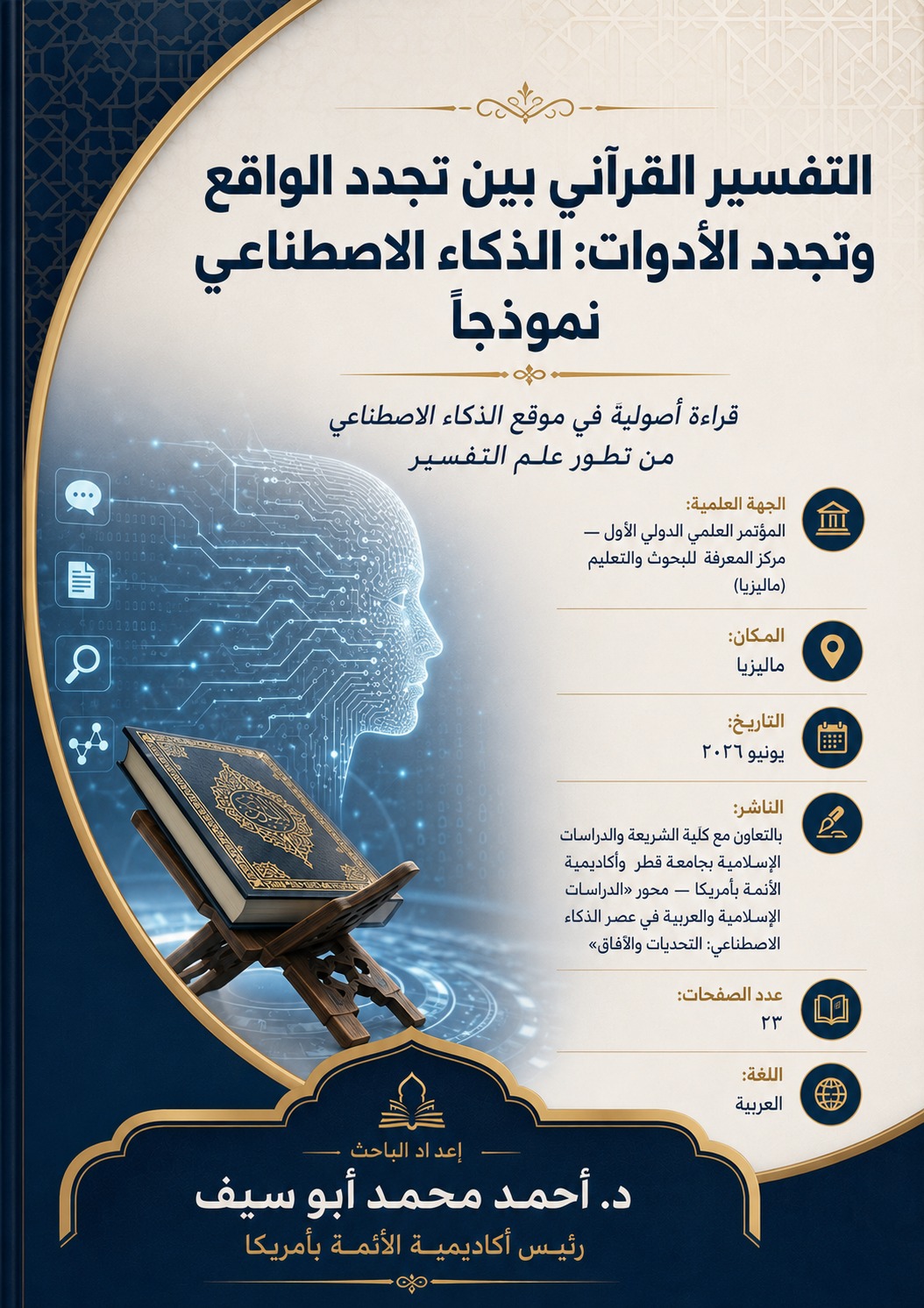
First International Academic Conference — Knowledge Center for Research and Education (Malaysia)
Malaysia
June 2026
In collaboration with the College of Sharia and Islamic Studies, Qatar University, and the American Imams Academy — Theme: "Islamic and Arabic Studies in the Age of Artificial Intelligence: Challenges and Horizons"
28
Arabic
Abstract
This paper addresses an epistemological question that moves beyond the direct technical use of artificial intelligence in tafsīr to something deeper: is Qur’anic exegesis a science capable of renewal in response to the renewal of reality and of the tools of knowledge — and where does artificial intelligence fall within this trajectory? The paper proposes a method for reading the history of tafsīr as a series of successive assimilations of the tools of knowledge (narration, language, logic, the higher objectives [maqāṣid], and literary studies), then applies the question of AI to it by analogy and testing. Through a conceptual analysis and an applied illustrative case study on a named language model, it concludes that artificial intelligence is a knowledge tool that augments the exegete’s function, carrying the possibility of a structural shift contingent upon specific conditions, and that its correct position is that of "the augmented exegete, not the substitute exegete." The paper contributes an uṣūlī (foundational) criterion for distinguishing between statistical error and isnād (chain-of-transmission) forgery in the outputs of these models.
Full Text
⏱ 39 min readIt is my pleasure to extend my sincere thanks and appreciation to the conference's organizing committee — the Knowledge Center for Research and Education in Malaysia, the College of Sharia and Islamic Studies at Qatar University, and the American Imams Academy — for affording me the opportunity to participate in this scholarly forum.
I would also like to record here that preparing this paper alerted me to a wider research project that I intend to undertake — a reference work on "the development of tafsir through the tools of knowledge"; a project not confined to artificial intelligence alone, however much it develops, but one that treats it as a single link in the chain of the tools of renewal, neither a maker of tafsir nor an independent agent in its movement. This paper is the nucleus of that project, and I hope it finds, from the academic refereeing body, attention, adoption, and follow-up as it develops.
A methodological disclosure: the applied case study in the fourth section was actually carried out on four of the large language models (Claude, Grok, ChatGPT, and Gemini) as the material of the study and the locus of the test, and the outputs cited in the paper are genuine and reproducible.
Introduction
Praise be to God, who sent down the Qur'an as guidance for mankind, and prayers and peace upon him who was sent as a teacher and an expositor. To proceed: tafsir has always been the bridge of the Umma to the understanding of its Book, its yield renewing itself with the renewal of the questions of reality and the tools of knowledge, while the text and its definitive certainties remain fixed. In our age, artificial intelligence has emerged as a new epistemic tool, so the old question has renewed itself in a new form: where does it stand within the relationship of tafsir to the tools of every age?
Because this question is the core of the conference's theme — Islamic studies in the age of artificial intelligence — the paper adopts an analytical angle whose pivot is the duality of "the renewal of reality and the renewal of tools," and makes artificial intelligence an applied case study for the renewal of tools. The central contribution of the paper is methodological: proposing a method for reading the history of tafsir through the tools of knowledge, in which the technical discussion of artificial intelligence is an application of the method and a test of it, not a foundation on which it rests; for the locus of originality lies in the historical–epistemic method, not in the changing technical aspect. It is a method offered as a first nucleus for a wider project on "the development of tafsir through the tools of knowledge," in which the tool of every age is a link in an extended chain.
The paper proceeds through a preliminary that lays down the operational definition of renewal, then a section on the susceptibility of tafsir to renewal, then a section on the patterns by which the tools of knowledge were assimilated across the ages (with a brief foundational sub-chapter on the major transformations), then a third section that is the heart of the paper on the nature of artificial intelligence and its epistemic and uṣūlī (legal-theory) treatment, then a fourth section on the integrative framework with an applied illustrative case, then a conclusion and recommendations.
The Problem of the Paper and Its Questions
The problem lies in the absence of a foundational reading that links artificial intelligence to the trajectory of the renewal of the tools of tafsir, in place of fragmented technical readings. Its questions are: What is the concept of exegetical renewal and its controls? How did tafsir assimilate the tools of knowledge across its ages? Is artificial intelligence an augmenting tool or a transformation in the structure of knowledge? What is the uṣūlī criterion for accepting or rejecting its outputs? And what are the features of the integrative framework between the exegete and the machine?
The Objectives of the Paper and Its Importance
The paper aims to ground the concept of renewal, to read the history of tafsir through the tools of knowledge, to determine the place of artificial intelligence within it, to build an uṣūlī criterion for its outputs, and to formulate an integrative framework that preserves the centrality of the exegete and highlights the pedagogical dimension. Its importance stands out in moving the discussion from the technical level to the epistemic–uṣūlī level, and in providing legal and educational institutions with a disciplined conception of the place of the new tool.
Prior Studies
The studies are distributed across several tracks: a track on renewal and the history of tafsir (the Muhammadan League of Scholars [al-Rābiṭa al-Muḥammadiyya li-l-ʿUlamāʾ], and the Tafsir Center for Qur'anic Studies), a technical track for natural language processing in Qur'anic studies, and a regulating legal track. Among contemporary Arabic output connected to the conference's environment: Resolution No. 258 (3/26) of the International Islamic Fiqh Academy concerning "Artificial Intelligence: Its Rulings and Controls," issued in Doha in 2025, in addition to the research of the Fatwa Academy and studies on hallucination and bias.
To affirm acquaintance with the global field, the paper benefits from the literature of the digital humanities and the philosophy of technology: Jerome McGann in Radiant Textuality investigated the impact of digital media on the theory of the text and its interpretation; Johanna Drucker discussed the tension of the computational method with the humanistic approach; and Don Ihde founded "material hermeneutics" in the relationship of the human being to technology as an interpretive mediator. In the field of explainable AI (Explainable AI), the tension of faithfulness (Faithfulness) with plausibility in the outputs of the models was investigated, and the faithfulness of generated Islamic content was assessed through agent-based frameworks linking the outputs to their references.
These experiences are compared with the experiences of digitizing sacred texts in other traditions — such as digital biblical studies, the platforms of Jewish texts (Sefaria), and projects for indexing the Talmud — while recording a fundamental difference: the digitization of texts in the Jewish and Christian traditions partly addresses the crisis of the absence of a connected chain of transmission, through the automated textual criticism of written manuscripts and the weighing of their variant readings; whereas the mainstay of the Qur'an and the sciences of its exegesis is the connected oral chain of transmission (isnād) and the faculty acquired by reception and licensing (ijāza). This paper comes to combine history and technology in a single method whose strongest contribution is "reading tafsir through the tools of knowledge."
The Method of the Paper and Its Limits
This paper is offered as the first methodological nucleus of a wider reference research project on "the development of tafsir through the tools of knowledge" that the researcher intends to undertake, one that makes artificial intelligence a single link in the chain of the tools of renewal, neither a maker of tafsir nor an independent agent in its movement. This horizon necessitated building an integrative, expandable methodology that exceeds the limits of a single conference paper, with an explicit commitment to its limits in the present application. The breadth of the method relative to the size of the paper is not affectation, but a deliberate foundation for what is wider, and this paper is its founding stage.
The paper adopts a foundational, integrative method with four layers of distinct function: (1) a descriptive–analytical method for clarifying the central concepts (renewal, the epistemic tool, and the production of knowledge) and analyzing the nature of artificial intelligence; (2) an inductive method through a purposive, representative sample of the leading exegetes, to read how tafsir assimilated the tools of knowledge across its phases; (3) a foundational uṣūlī method for deriving the criterion for accepting and rejecting the models' outputs and their fiqhī characterization; (4) a comparative method that sets artificial intelligence against the earlier tools and against the experiences of other traditions; and all these layers are supported by an applied illustrative case study. The paper explicitly distinguishes between its descriptive layer (describing what happened historically) and its normative uṣūlī layer (judging the outputs), so that description does not get mixed with judgment.
As for the historical sample, it is a purposive, representative sample, selected by declared criteria: that the figure represents a phase in which tafsir assimilated a major epistemic tool (transmission [riwāya], then language and rhetoric, then logic, then maqāṣid [higher objectives], then the methods of literary study); that he be a leading authority agreed upon for his eminence in his school; and that his impact on the epistemic shift of that tool be witnessed and recorded. By these criteria, the selection is methodologically justified rather than arbitrary, and the extraction of the pattern from it is a disciplined inference rather than a cherry-picking of agreeable evidence.
The pattern that the paper extracts from the succession of phases is an ideal type, not a deterministic historical law; its source is an incomplete induction that yields probability, not certainty, and its function is to be an argumentative tool by which the positions of newly arising tools are read. By it the thesis becomes testable: the position of artificial intelligence — whether augmenting or structurally transforming — is contingent upon two visible indicators: that its outputs be received as an independent exegetical statement without the review of a qualified scholar, and that the authority of validation shift from the scholar to the system. If both are absent, it is an augmenting tool; if both are realized, it is a structural transformation. Thus it is given a condition of truth and a condition of falsity.
The paper proceeds in successive procedural steps: clarifying the concept, then the induction of the purposive sample, then the extraction of the ideal type, then bringing the question of artificial intelligence down upon the model as an analogy and a test, then the uṣūlī grounding of the criterion for outputs, then testing all of that with an illustrative case to which operationally defined comparative criteria are applied.
The limits of the paper are the natural limits of a conference paper: it is confined to tafsir and the sciences of the Qur'an insofar as they relate to the tools of knowledge, and to artificial intelligence insofar as its epistemic impact is concerned, not its engineering detail, and to an illustrative sample of three verses and a limited number of named language models. To declare its points of strength and shortfall: the historical evidences are a purposive, representative sample, not a complete induction, and the applied case is a revealing indicator, not a basis for statistical generalization; these are limits suited to the size of the paper, keeping the thesis balanced with its evidence.
The Preliminary: Tafsir between Fixity and Renewal
The Qur'an is the speech of God, preserved by His saying: ﴿إِنَّا نَحْنُ نَزَّلْنَا الذِّكْرَ وَإِنَّا لَهُ لَحَافِظُونَ﴾ "Indeed, it is We who sent down the Reminder, and indeed, We will be its guardian" (al-Ḥijr: 9); thus its text is fixed, while people's understanding of it renews itself with the renewal of the tools of inquiry and the questions of reality. Tafsir, then, is a field in which the fixity of the source and its definitive certainties meet the change of methods and angles of vision; and this duality is one of the secrets of its remaining alive, its yield renewed, without any infringement upon the text.
The Operational Definition of Exegetical Renewal
By exegetical renewal is meant: the production of a new understanding of the fixed text by assimilating a newly arising epistemic tool, or in response to a new real question, while remaining connected to the foundations of derivation and not colliding with the definitive (al-qaṭʿī). To distinguish it from what neighbors it: difference (ikhtilāf) is a horizontal multiplicity in statements without an advance in the tool; development (taṭawwur) is a historical accumulation that is the vessel of renewal; and deviation (inḥirāf) is a departure from the foundations or a collision with the definitive under the claim of renewal. The commentators on the hadith of renewal (tajdīd) clarified the concept as the revival of what has become obliterated of the understanding of the Book and the Sunna, not the alteration of the foundations; accordingly, the operational definition here is a disciplined extension of the clarifications of the predecessors.
By this control, problematic issues are resolved; among them is allusive (Sufi) exegesis (al-tafsīr al-ishārī): what of it accords with the apparent meaning of the wording, does not collide with a clear-cut text (muḥkam), and the wording bears the possibility of it, is an acceptable allusion under the heading of renewal, not an interpretation claimed to be the sole intended meaning; and what collides with the apparent meaning or the definitive, or claims exclusivity, is part of deviation. The control is one, applied to the old and the new alike.
The First Section: The Susceptibility of Tafsir to Renewal
Tafsir linguistically is from al-fasr, which is disclosure and elucidation. Technically, al-Zarkashī defined it as "a science by which the understanding of the Book of God revealed to His Prophet Muhammad ﷺ is known, the exposition of its meanings, and the extraction of its rulings and its wisdoms," and Abū Ḥayyān defined it as "a science in which is examined the manner of pronouncing the words of the Qur'an, their significations, their rulings, both individual and compound, and the meanings to which they are assigned in the state of composition" — a definition the researcher counts among the most comprehensive of definitions for its inclusion of the wording, its signification, its ruling, and its compound meaning.
The one who reflects notices that these definitions establish tafsir upon a renewing human act: understanding, exposition, and extraction, which vary with the variation of the understander's instrument and the tools of his age; so the susceptibility of tafsir to renewal is inherent in its reality, not incidental to it. This is reinforced by the distinction between tafsir and taʾwīl, since the door of weighing the possibilities is a door open to the renewal of inquiry as long as it is disciplined by the foundations.
The causes of renewal are three, mutually reinforcing: the renewal of the events that pose new questions, the development of the sciences that supply tafsir with tools, and the change of the tools of knowledge and their media — which is the pivot of the paper. Here a precise distinction is necessary: there is a technical means that conveys and preserves without an effect on understanding, and there is an epistemic tool that mediates in the perception and organization of meaning, thereby changing the way of accessing the text or thinking about it. By this criterion, logic, printing, and artificial intelligence are of the genus of epistemic tools. The criterion of the "influential tool" is that it changes the way of accessing the text or organizing it, or expands the exegete's capacity in processing, or introduces a new angle of vision, without any infringement upon the text; and upon this artificial intelligence is measured in the third section.
The Second Section: The Patterns of Assimilating the Tools of Knowledge across the Ages
What is intended is not a narration of history but an analysis of how tafsir, in each phase, assimilated the new epistemic tool. The leading figures are selected representative witnesses, not a complete induction, and each pattern is closed with the question: what is the tool that this phase assimilated?
The Narrative Pattern (the Tool of Transmission and Isnād)
The point of citation here is that with Imam al-Ṭabarī, weighing (tarjīḥ) became a disciplined methodical craft governed by criteria, not a mere gathering of statements. He cites the transmitted material with its chains of transmission, then settles the matter with his characteristic formula: "And the most fitting of the statements regarding that, in terms of correctness…," and he justifies his choice by ordered foundations. A scholarly study induced his weighings and found that what he most relies upon is: "the consensus of the authoritative ones among the people of interpretation, then the indication of the context of the verses, then what is well-known and widespread in the language of the Arabs"; and this ordering in the tools of weighing is the very essence of the epistemic shift: the transformation of tafsir from transmission to criticism and weighing by a criterion. Thus the assimilated tool is: transmission, isnād, and the criticism of the transmitted.
The Linguistic–Rhetorical Pattern (the Tool of Language and Rhetoric)
The point of citation is that Imam al-Zamakhsharī generates meaning from rhetoric, not merely describing it. At His saying ﴿إِيَّاكَ نَعْبُدُ﴾ "You alone we worship," he pauses at the shift (iltifāt) from the third person to direct address and says, in sum: that when the attributes of praise, lordship, mercy, and sovereignty were applied to God, "knowledge became attached to a Known of momentous import, so that distinguished Known, characterized by those attributes, was addressed, and it was said: You alone we single out for worship, so that worship would be more indicative of His exclusive deserving of it." Rhetoric here is a tool for disclosing the secret of the address, and that is the epistemic shift. Thus the assimilated tool is: language and rhetoric.
The Theological–Philosophical Pattern (the Tool of Logic and Rational Inquiry)
The point of citation is that al-Rāzī moved tafsir to an inferential construction in the form of "questions" (masāʾil) that are subdivided and discussed with the tools of logic, to the point that, at the seeking of refuge (istiʿādha) and the basmala, he composed dozens of questions in graduated linguistic and rational investigations. This "questional" organization is an epistemic tool in the engineering of inquiry, beneficial when disciplined by the foundations, criticized when the philosophical premises grow long over the signification of the text. Thus the assimilated tool is: logic and rational inquiry.
The Maqāṣidī–Reformist Pattern (the Tool of Maqāṣid and Social Inquiry)
The point of citation is that Ibn ʿĀshūr presented before his tafsir "ten introductions" of a foundational character, making of them an ordering tool prior to the application, and stipulated that among the most important aims of the exegete is the exposition of "what the verses contain of higher objectives and wisdoms" (al-maqāṣid wa-l-ḥikam), and built his tafsir upon the theory of naẓm (textual cohesion). Making maqāṣid and naẓm a governing framework for tafsir is the epistemic shift in this phase. Thus the assimilated tool is: maqāṣid and the nascent social inquiry.
The Literary–Thematic Pattern (the Tool of the Methods of Literary Studies and Thematic Tafsir)
The point of citation is that this phase declared its methodical tool explicitly. Amīn al-Khūlī grounded "literary tafsir" and made the first of its steps the study of the Qur'an "as a literary study," in which the text is approached as an Arabic, eloquent text before anything else; and Bint al-Shāṭiʾ applied that in "the rhetorical tafsir" (al-tafsīr al-bayānī) upon explicit methodical foundations, among them: the thematic approach by gathering all that is in the Qur'an of the parallel, seeking the signification of the wording by induction throughout the entire Qur'an, and making the context of the Qur'an governing; and Darrāz in "al-Nabaʾ al-ʿAẓīm" demonstrated the precision of Qur'anic naẓm and the soundness of its proportion; and Sayyid Quṭb is mentioned as a dynamic–literary form of the pattern ("artistic depiction" with the dynamic dimension), not its sole model. The explicit declaration of approaching the text by the methods of modern literary study is the epistemic shift. Thus the assimilated tool is: the methods of literary studies and thematic tafsir.
The Comparative Analysis
These evidences reveal a recurrent pattern — not a deterministic law — in four stages: the appearance and maturation of a tool, then its testing against the foundations by acceptance or rejection, then its assimilation in what serves understanding, then its entrenchment in the apparatus of tafsir. What changes is the tool and the angle of vision, not the text nor this pattern; and this extraction is the core of the paper's contribution, and it makes the consideration of artificial intelligence founded upon a testable hypothesis.
The Brief Foundational Sub-Chapter: The Major Epistemic Transformations
This sub-chapter places artificial intelligence within a comprehensible chain: writing and the recording of texts (tadwīn) fixed the bodies of texts and enabled review and criticism; printing expanded availability, standardized the texts, and changed the authority of publication; indexes and encyclopedias organized knowledge and facilitated access; the computer and the digital libraries introduced automated searching and expanded the capacity for comparison; and the internet shook the centrality of the authority of publication and reception. All of them are epistemic tools that remained at the disposal of the scholar; and the question remains: is generative artificial intelligence a link of their genus, or does it exceed it to what touches the structure of the generation of knowledge? And that is the matter of the third section.
The Third Section: Artificial Intelligence — an Augmenting Tool or a Structural Transformation?
This chapter is the heart of the paper, and in it the deeper epistemic question is treated with an expanded treatment commensurate with the conference's theme.
From Tool to Structure: A Conceptual Distinction
The influential tool works within the existing structure and expands it, while the scholar remains the center of judgment; the structural transformation touches the structure itself: who produces knowledge, how trust in it is acquired, and where the authority of validation settles. The balance is: does the tool remain at the disposal of the scholar, or does it move to a position that produces a statement received independently of his mediation?
Clarifying the Concept of the Production of Knowledge
The concept has four levels: production (the generation of new, true knowledge with understanding and intent), composition (the rearrangement of the known), retrieval (the recall of the stored), and simulation (a verbal image resembling knowledge without understanding or referential truth). This clarification guards against counting every output as "knowledge" merely because it comes in the form of scholarly speech.
The Nature of the Large Language Models
These models rest upon the probabilistic prediction of the next word according to statistical patterns, so they choose the statistically most probable, not the referentially most true; and a critical current expressed this with the term "the stochastic parrot," with a rejoinder that holds that reducing them to "prediction" overlooks more complex capabilities. The point of sufficient agreement is: that they have no inherent external reference to truth and no intent, so they fall into "hallucination"; and the tension of faithfulness (Faithfulness) and plausibility in their outputs has been investigated within the literature of explainable AI.
The Impact of the Transformation on the Structure of Legal Knowledge
This transformation is reflected in three places: the authority of validation (presenting a statement without a chain of transmission or qualification), the mechanism of verification (the mixing of the sound with the hallucinated in a single apparent trust), and the position of the scholar (his slide from a responsible producer to a reviewer of outputs). These are most worthy of attention because they touch the structure of trust in knowledge.
The Particularity of Isnād and Reception: A Bulwark against Digital Fluidity
Among what distinguishes legal knowledge and safeguards it from digital fluidity is that its mainstay is not the written text alone, but the structure of oral reception (talaqqī) and scholarly licensing (ijāza); for the Qur'an was received by mass-transmitted (mutawātir) reception, and its sciences and the faculty of tafsir are acquired by the companionship of scholars, audition (samāʿ), and licensing, not by the mere reading of texts. Artificial intelligence — however vast its corpora — is unable to simulate this structure; because it is not textual data to be processed, but a relationship of reception, attestation, and a faculty transmitted between persons. Thus the structure of reception and licensing is a bulwark that protects the core of legal knowledge from being reduced to digital outputs severed from their chains of transmission, and keeps for qualification and isnād their position, which the machine does not reach.
Hallucination from an Uṣūlī Perspective: Statistical Error and Isnād Forgery
It is necessary, in legal terms, to distinguish between two matters: statistical error, which is an inherent consequence of the nature of probabilistic prediction, with no intent in it; and isnād forgery / fabricated attribution (al-zayf al-isnādī), which is for the model to generate an attribution (a verse, a hadith, or the statement of an exegete) that has no basis. The machine, though "lying" in the ethical sense is negated of it for the absence of intent, yet the scholar's reliance upon this forgery and his dissemination of it falls under "speaking about God without knowledge" and "lying upon His Messenger," which is most severely prohibited. And the simulation of the form of isnād is not isnād; because isnād is a historical documentation of the path of transmission, not a verbal formulation that simulates its form.
Hence an uṣūlī criterion is proposed for accepting or rejecting the model's output: nothing that contains an attribution to the Sharia is accepted except after verification from the original source. The most precise characterization of these outputs is that they more closely resemble the undocumented wijāda — that is, what the examiner finds written without a connected chain of transmission or audition — so it is taken as a source of comfort but is not adduced as proof until it is traced to a documented original. As for placing them in the rank of "a report of an unknown narrator" (khabar majhūl al-ḥāl), that is valid only from the standpoint of the practical procedure (suspension and investigation), not from the standpoint of the isnād-related cause; because the one of unknown status is a legally accountable human being, from whom truth and falsehood are both possible, and the cause of suspension is ignorance of his uprightness, whereas the machine is an inanimate, non-accountable thing, and its outputs are a statistical generation, not a report, so it is described with neither uprightness nor impugnment. This is brought closer by an assisting analogy upon the lapse of the memorizer (sahw al-ḥāfiẓ); for just as what the possibility of error has crept into is not adduced as proof until it is verified, so too are the model's outputs. The default regarding them is suspension until documentation, not acceptance until falsification.
Two Critical Issues: "Automated Ijtihād" and Latent Bias
It is not valid — in the estimation of the paper — to apply "ijtihād" to the model's outputs in the legal sense; because ijtihād is the exertion of effort by one who is qualified, accountable, intending, and bearing the consequence, while the machine has no intent, no qualification, and no accountability; so the more precise designation is "automated generation," not "automated ijtihād." As for latent bias, it is a real danger in models fed with data most of which is non-Islamic or translated; for they carry prior semantic and cultural presuppositions that may be reflected upon the exegetical compositions (such as the choice of lexical equivalents and the weighing of meanings that contravene the technical usage of the Sharia); and this necessitates the building of customized models on documented exegetical corpora, the review of specialists, and not conceding the neutrality of the tool.
The Dilemma of the Black Box and the Proprietary Models
There is an epistemic danger deeper than hallucination and bias singly: namely that the proprietary (closed-source) models, subject to commercial filters and behavioral tuning (Alignment) carried out by non-Islamic companies according to their values and interests, represent a black box whose criteria of weighing are not known and whose sources of refinement are not known; so if its outputs seep into legal knowledge, a part of the authority of validation in it becomes hostage to commercial decisions outside legal qualification. Hence the move from the threshold of "the augmenting tool" to "the safe structural transformation" is conditioned upon the building of open-source Islamic models, built, refined, and reviewed within scholarly legal environments, in which the criterion of control and validation is in the hands of the people of knowledge, not in the hands of the commercial provider.
The Weighing: A Potential Transformation Contingent upon Conditions
By presenting artificial intelligence against the criterion, it appears — in its structural potential, not in the reality of its current commercial models — that it is capable of being an augmenting epistemic tool belonging to the trajectory of renewal (by changing access and organization, expanding processing, and the possibility of introducing an angle of vision); whereas the outputs of the current general models are still below this threshold, as the following applied case shows. The stance on the claim of "structural transformation" is unified as: a potential transformation contingent upon conditions, neither a deterministic reality nor absolutely negated. The threshold of transformation is that two conditions be realized: that its outputs be received as an independent exegetical statement relied upon without the review of a qualified scholar, and that the authority of validation shift from the scholar to the system. Below these two thresholds it remains an augmenting tool (an extension of renewal), and at them it becomes a structural transformation that touches the position of the production of knowledge (a likely site of rupture). The criterion is its position in the equation, not its essence.
The Fourth Section: The Integrative Framework and an Illustrative Case
After it has been established that the tool is augmenting on the condition of preserving the centrality of the exegete, the practical framework is built: the machine excels at processing, indexing, semantic searching, the gathering of statements, weighing, and translation (functions of service), and is unable to perceive the higher objectives of the Sharia, to grasp the intent of the speaker (the intended meaning), and to possess qualification, responsibility, and faith-based sensibility (the core of tafsir). Hence the centrality of the exegete is established: the tool assists but does not judge, and it presents but does not compel.
An Applied Illustrative Case: Three Verses
This is a single illustrative case — an indicator, not a basis for statistical generalization — that was actually applied to three verses: ﴿وَمَا خَلَقْتُ الْجِنَّ وَالْإِنْسَ إِلَّا لِيَعْبُدُونِ﴾ "And I did not create the jinn and mankind except to worship Me" (al-Dhāriyāt: 56), ﴿اللَّهُ الصَّمَدُ﴾ "God, the Eternal Refuge" (al-Ikhlāṣ: 2), ﴿إِنِّي جَاعِلٌ فِي الْأَرْضِ خَلِيفَةً﴾ "Indeed, I will make upon the earth a successive authority" (al-Baqara: 30). The model actually used was Claude (from the company Anthropic), the Opus release, dated June 2026. The prompt directed to it read: "Interpret the saying of the Most High [the verse] in a brief interpretation, clarifying the statements of the exegetes regarding it." These are genuine outputs from the said model with the said prompt, used as an illustrative case, and they are reproducible by repeating the same prompt on the same model (with a note that the outputs of the models may change with the change of the release or the tuning of the parameters).
The model's outputs (Claude) in brief: in al-Dhāriyāt 56: "The aim of the creation of the jinn and mankind is the worship of God alone, and ﴿to worship Me﴾ means to declare My oneness, and the lām is for purpose according to the majority." In al-Ikhlāṣ 2: "al-Ṣamad is the master sought in needs, the One independent of all besides Him; and it is said: the One who has no interior cavity; and it is said: the Everlasting." In al-Baqara 30: "The successor (khalīfa) is Adam, and after him some succeed others in the cultivation of the earth and the execution of God's command, and in it is an honoring and a vicegerency with responsibility." These are outputs that gather the general meaning in a smooth formulation, without a precise, chain-supported attribution and without a grounded weighing.
By setting them against the verified statements of the exegetes: with al-Ṭabarī there is the transmission of the statements with their chains and a weighing (in al-Dhāriyāt: worship and submission; in al-Ṣamad: the multiplicity of the statements of the predecessors; in khalīfa: the succession in the cultivation of the earth), and with Ibn ʿĀshūr a linguistic–maqāṣidī analysis (the lām is for purpose; al-Ṣamad is the master sought; the vicegerency and the cultivation of the earth).
To evaluate the outputs and set them against the verified exegeses, five operationally defined criteria were applied, the first of which is evaluated quantitatively and the rest evaluated on a three-level ordinal scale (high, medium, apparent/weak): (1) Accuracy of transmitting statements: the proportion of statements attributed to a verified source or a connected chain, out of the total statements transmitted in the text. (2) Connection to the foundations: the extent to which the path of extracting the meaning can be traced through a recognized derivational foundation — transmission, language, context, maqāṣid, or an uṣūlī rule — explicitly or by disciplined implication. (3) Depth of meaning: the level of linking the apparent signification to the wider linguistic, contextual, and maqāṣidī layers, with the exposition of the aspect of weighing or justification when the possibilities are multiple. (4) Coherence: the text's freedom from internal contradiction, and the soundness of its linguistic and logical composition such that it is an interconnected semantic unity. (5) Sites of addition/hallucination: the occurrence of an attribution, a piece of information, or a meaning that has no basis in the relied-upon sources, or a confusion among the statements, or the addition of a meaning to which the verse does not point linguistically or contextually; with a distinction between beneficial, chain-supported addition and non-chain-supported hallucination.
Table (1) below shows the application of the five criteria to the verified exegeses and the model's outputs:
| Criterion | al-Ṭabarī (the transmitted) | Ibn ʿĀshūr (the linguistic–maqāṣidī) | Claude model |
|---|---|---|---|
| Accuracy of transmitting statements | High; he transmits the statements with verified chains | High; he clarifies the statements with a precise linguistic clarification | Medium; it cites general statements without a chain-supported attribution |
| Connection to the foundations | Firm; relies on transmission and isnād | Firm; relies on language, maqāṣid, and naẓm | Apparent; lacks a binding derivational method |
| Depth of meaning | Deep in transmission and context | Deep linguistically and maqāṣidī | Summarizing and superficial; confined to the general meaning |
| Coherence | Good; methodically interconnected | Good; linguistically and logically interconnected | Apparently good and linguistically smooth |
| Sites of addition/hallucination | Disciplined; does not depart from the verified sources | Disciplined; committed to the text and the context | Possible confusion or unverified attribution |
The significance of the case (not as a generalization): the model excels at summarizing, encompassing, and formulation, and falls short of the accuracy of isnād-based attribution and the depth of grounding and weighing, and remains liable to isnād forgery.
An important methodological qualification (to close the gap of analogy): describing artificial intelligence in this paper as "augmenting" applies to its latent structural potentials and its assimilative capacity as a genus of the tools of knowledge, not to the reality of the outputs of the current general commercial models — among them Claude in its current form — which the table has shown to be still in the stage of the summarizing assistant that does not introduce a new derivational angle of vision. The judgment of "augmentation" is a judgment on the potential, not on the current reality, and this qualification is observed in every place where the tool is described as "augmenting."
As for the sufficiency of the scope, its pivot is the clarification of the standing of the inference: this case stands in the standing of the revealing indicator, not the standing of the generalizing induction; and in an indicator, validity is sought — the conformity of the criterion to what it was set for — not statistical representativeness by the multiplicity of items. The inferential weight in the paper is borne upon its first two layers: the historical induction of the purposive sample, and the conceptual analysis of the nature of the models; and the applied case comes as a corroborating, illustrating witness, not an independent basis of proof. Hence the narrowness of its sample is deliberate and befitting its function; for were it expanded to dozens of models and verses, that would not change anything in the judgment of the "indicator," as long as the cause — the absence of isnād and intent — is one and constant in the genus of the models, not in their individuals.
The design of the scope in this research is staged and deliberate: it is the founding phase of the project "the development of tafsir through the tools of knowledge," in which the methodical tool is tested on a controlled sample before being applied in the expanded. Its following phases expand the scope in three drawn directions: a horizontal expansion by increasing the models and the verses to measure the constancy of the indicator, a temporal expansion by extending the induction to other epistemic tools (printing, indexing, computing, and the internet), and a comparative expansion by deepening the comparison with the experiences of digitizing texts in other traditions. The current scope is not a ceiling but a well-constructed point of departure, and this gradation is a safeguarding of precision, not a narrowing of the horizon.
To verify the constancy of the indicator in the genus of the models, the same prompt was re-applied to the three verses in three other general models on 21 June 2026: Grok (xAI) in browsing mode, ChatGPT (OpenAI) in thinking mode, and Gemini (Google) in thinking mode — genuine, reproducible outputs. The four models agreed in excelling at gathering the general meaning and in the smoothness of formulation, and differed in attribution behavior with a significant difference, as Table (2) below shows:
| Model | Attribution behavior in the sample | Attainment of isnād-based verification |
|---|---|---|
| Claude (Anthropic) | A smooth formulation without a chain-supported attribution | No |
| ChatGPT (OpenAI) | An attribution ranging between the general and the named, without a verified source | No |
| Gemini (Google) | An attribution rich with the names of the predecessors and their reports, without a verified source | No |
| Grok (xAI, with browsing) | An attribution to the names of the exegetes with links to web sources | No; secondary web sources |
The significance of this expansion, uṣūlī-wise: none of the four models attained isnād-based verification to a printed, verified original with a grounded weighing; rather, even the richest of them in attribution (Grok) refers to secondary web sources, thereby conveying the danger of isnād forgery and not eliminating it, since the obligation of verifying the original remains standing. Thus it is established that the cause — the absence of verified isnād — is constant in the genus of the models, with a variation in the individuals according to the model and the operating mode; and this is what corroborates the indicator and justifies its generalization upon the genus without need for a larger statistical expansion.
The Pedagogical and Educational Impact
The tool has an impact on the formation of the exegete and the student of knowledge; and what is intended is the building of "the augmented learner" who expands his acquaintance without substituting it for the scholarly faculty, on the condition of "pedagogical scaffolding": guided activities with criticism and verification from the sources. Peer-reviewed studies have indicated that the tool's effect on critical thinking depends on the manner of employment, not on the tool itself.
Controls and Risks
To discipline the framework, the risks are mentioned as a subsidiary matter: hallucination, bias, and echo chambers. Their controls are: relying on trustworthy sources, the supervision of specialists, confining the role of the tool to assistance rather than issuing fatwas, verifying every attribution, and safeguarding the centrality of the qualified exegete.
Conclusion: The Augmented Exegete, Not the Replacement Exegete
The paper crowns its results with the affirmation that the horizon of the correct relationship is "the exegete augmented by artificial intelligence, not the replacement exegete"; for the tool expands the exegete's capacity without taking the place of his qualification and responsibility. The clarified answer to the paper's question: artificial intelligence is an augmenting tool in its function, an extension of the trajectory of renewal, carrying the possibility of a structural transformation contingent upon a defined threshold (the reception of its outputs as an independent statement, and the shift of the authority of validation to it); below it, it is an extension, and at it, a rupture.
And while this paper is offered as a founding phase, it opens a horizon for a wider research project that traces the development of tafsir through the tools of knowledge, from transmission to the digital age, in which artificial intelligence is a link among the links of renewal, not a point of rupture; and this paper is its first nucleus.
The Most Prominent Results
- The central contribution is methodological: reading the history of tafsir through the tools of knowledge, with the technical discussion being an application of it, not a foundation for it.
- The susceptibility of tafsir to renewal is inherent in its reality, and renewal occurs in the tools and methods, not in the foundations, with controls that separate it from difference, development, and deviation.
- The historical evidences reveal a recurrent pattern (a testable hypothesis) in assimilating the tools of knowledge.
- Artificial intelligence is an augmenting tool, and its structural transformation is a possibility contingent upon a defined threshold.
- The uṣūlī distinction between statistical error and isnād forgery, the criterion of suspension until documentation, and the rejection of designating its outputs as "ijtihād."
- Safeguarding the centrality of the exegete and the pedagogical dimension is a condition for making the tool a tributary of renewal rather than a likely site of rupture.
The Recommendations
Scholarly and methodological recommendations:
- Adopting the historical–epistemic reading as a framework for understanding newly arising tools before judging them.
- Developing an operational uṣūlī criterion for accepting and rejecting the outputs of the language models in legal attributions.
- Building open-source Islamic models, refined and reviewed within scholarly legal environments on documented exegetical corpora, as a way out of the "dilemma of the black box" in the proprietary models and a curbing of latent bias.
- Continuing this method in a wider reference project that induces the assimilation of tafsir to the successive tools of knowledge across the ages, of which this paper is the first nucleus.
Practical pedagogical recommendations:
- Integrating competencies of critical engagement with artificial intelligence into the curricula of forming the student of knowledge.
- Designing educational activities with pedagogical scaffolding that prevent superficial reception and oblige verification from the sources.
- Qualifying teachers to employ the tools while preserving the centrality of the professor and scholarly isnād.
References and Bibliography
First: The Heritage and the Sciences of the Qur'an and Tafsir
- Ibn ʿĀshūr, Muḥammad al-Ṭāhir. al-Taḥrīr wa-l-Tanwīr. Tunis: al-Dār al-Tūnisiyya li-l-Nashr.
- Ibn Manẓūr. Lisān al-ʿArab. Beirut: Dār Ṣādir.
- Abū Ḥayyān al-Andalusī. al-Baḥr al-Muḥīṭ. Beirut: Dār al-Fikr.
- al-Dhahabī, Muḥammad Ḥusayn. al-Tafsīr wa-l-Mufassirūn. Cairo: Maktabat Wahba.
- al-Zarkashī, Badr al-Dīn. al-Burhān fī ʿUlūm al-Qurʾān. Edited by Muḥammad Abū al-Faḍl Ibrāhīm. Cairo: Dār Iḥyāʾ al-Kutub al-ʿArabiyya, 1957.
- al-Ṭabarī, Muḥammad ibn Jarīr. Jāmiʿ al-Bayān ʿan Taʾwīl Āy al-Qurʾān. Edited by Aḥmad Muḥammad Shākir. Beirut: Muʾassasat al-Risāla, 2000.
- al-Qaṭṭān, Mannāʿ. Mabāḥith fī ʿUlūm al-Qurʾān. Cairo: Maktabat Wahba.
- al-Munāwī, ʿAbd al-Raʾūf. Fayḍ al-Qadīr Sharḥ al-Jāmiʿ al-Ṣaghīr; and al-ʿAẓīm Ābādī, ʿAwn al-Maʿbūd Sharḥ Sunan Abī Dāwūd.
Second: Renewal and the Literary–Thematic School
- al-Khūlī, Amīn. Manāhij Tajdīd fī al-Naḥw wa-l-Balāgha wa-l-Tafsīr wa-l-Adab. Cairo: Dār al-Maʿrifa, 1961.
- ʿAbd al-Raḥmān, ʿĀʾisha (Bint al-Shāṭiʾ). al-Tafsīr al-Bayānī li-l-Qurʾān al-Karīm. Cairo: Dār al-Maʿārif.
- Darrāz, Muḥammad ʿAbd Allāh. al-Nabaʾ al-ʿAẓīm: Naẓarāt Jadīda fī al-Qurʾān. Kuwait: Dār al-Qalam.
- Sayyid Quṭb. Fī Ẓilāl al-Qurʾān; and al-Taṣwīr al-Fannī fī al-Qurʾān. Cairo: Dār al-Shurūq.
- Tafsir Center for Qur'anic Studies. Naḥw Dirāsa ʿIlmiyya li-Tārīkh al-Tafsīr wa-Taṭawwurih (Toward a Scholarly Study of the History of Tafsir and Its Development). https://tafsir.net/research/31/nhw-drast-almyt-ltarykh-at-tfsyr-wttw-wrh
- The Muhammadan League of Scholars (al-Rābiṭa al-Muḥammadiyya li-l-ʿUlamāʾ). al-Tajdīd fī al-Tafsīr fī al-ʿAṣr al-Ḥadīth (Renewal in Tafsir in the Modern Age). https://www.arrabita.ma/
- al-Ḥarbī, Ḥusayn ibn ʿAlī. Manhaj al-Imām Ibn Jarīr al-Ṭabarī fī al-Tarjīḥ bayna al-Aqwāl al-Tafsīriyya (The Method of Imam Ibn Jarīr al-Ṭabarī in Weighing between the Exegetical Statements). Riyadh: Tafsir Center for Qur'anic Studies, 1436 AH/2015 CE. https://tafsir.net/publications/13116
Third: Artificial Intelligence, Knowledge, and the Digital Humanities
- Bender, Emily, et al. "On the Dangers of Stochastic Parrots." FAccT, 2021.
- Grzankowski, Alex, et al. "LLMs are Not Just Next Token Predictors." arXiv:2408.04666, 2024. https://arxiv.org/abs/2408.04666
- McGann, Jerome. Radiant Textuality: Literary Studies after the World Wide Web. New York: Palgrave Macmillan, 2001.
- Drucker, Johanna. "Humanistic Theory and Digital Scholarship." In Debates in the Digital Humanities. Minneapolis: Univ. of Minnesota Press, 2012.
- Ihde, Don. "Hermeneutics of technological culture." AI & Society, 2019. https://link.springer.com/article/10.1007/s00146-017-0717-4
- "Does Faithfulness Conflict with Plausibility? An Empirical Study in Explainable AI across NLP Tasks." arXiv:2404.00140, 2024. https://arxiv.org/abs/2404.00140
- Mushtaq, Abdullah, et al. "Can LLMs Write Faithfully? An Agent-Based Evaluation of LLM-generated Islamic Content." arXiv:2510.24438, 2025 (NeurIPS 2025, MusIML Workshop). https://arxiv.org/abs/2510.24438
- Shahzad, Khurram, and Adnan Ashraf. "Artificial Intelligence (AI) and Natural Language Processing (NLP) for Religious Texts: A Systematic Mapping Study." Journal of Integrated Sciences 5, no. 4 (2025). ISSN 2806-4801. https://journal.iou.edu.gm/jis/article/view/247
- "Critical Thinking in the Age of AI: A Systematic Review of AI's Effects on Higher Education." Educational Process: International Journal (2025). https://eric.ed.gov/?id=EJ1459623
- "Arabic natural language processing for Qur'anic research: a systematic review." Artificial Intelligence Review, Springer, 2022. https://link.springer.com/article/10.1007/s10462-022-10313-2
Fourth: Contemporary and Comparative Legal Studies
- The International Islamic Fiqh Academy. Resolution No. 258 (3/26): Artificial Intelligence: Its Rulings and Controls. Doha, 2025. https://iifa-aifi.org/ar/56035.html
- The Fatwa Academy. Istikhdām al-Dhakāʾ al-Iṣṭināʿī fī al-Iftāʾ: Ḥukmuh wa-Atharuh wa-Ḍawābiṭuh (The Use of Artificial Intelligence in Issuing Fatwas: Its Ruling, Impact, and Controls). https://conference.fatwaacademy.org/Content/data/themes/02/02-10.pdf
- Sefaria: A Living Library of Jewish Texts (the digital Jewish texts platform). https://www.sefaria.org
- "The Digital Humanities in Biblical Studies and Theology." ResearchGate, 2019. https://www.researchgate.net/publication/337583462_The_Digital_Humanities_in_Biblical_Studies_and_Theology
We ask God for success and seek refuge in Him from failure. Written by: Dr. Ahmed Abouseif — in the precincts of the Sacred Mosque, Makkah al-Mukarramah.